




16 January 2026
The euro area yield curve steepened significantly in 2025 as long-term and especially very long-term interest rates increased. This ECB Blog post dissects what happened and explores key drivers behind the unusually strong shift.
Over the course of 2025, many debtors in the euro area faced the phenomenon that borrowing over longer time periods has become more costly relative to borrowing over the shorter term. Experts call this a steepening of the yield curve.
The term structure of interest rates is always a prominent topic for financial markets, banks and monetary policymakers. The recent steepening is especially interesting as it is stronger than in previous credit cycles. In fact, in parts of the yield curve we can observe some of the strongest slope increases since the introduction of the euro. In this blog post, we break down the anatomy of the steepening, put the shift into historical perspective and assess the factors behind it.
Anatomy of a steepening
Let’s start by looking at the euro area risk-free curve, a benchmark for financing costs in all sectors across the economy.[1] Chart 1 shows where this curve stood at the end of 2025 (top panel, blue curve) compared with the end of 2024 (top panel, yellow curve). It also highlights how risk-free rates at various maturities – that is, different periods over which borrowed funds need to be paid back – changed during that time (bottom panel). The chart further provides historical context by showing the curve’s long-term average since the introduction of the euro (top panel, red curve).
Chart 1
Euro area risk-free yield curve, levels and changes in 2025
(top panel: percentages per annum; bottom panel: basis points)

Sources: Bloomberg, LSEG and ECB calculations.
Notes: Risk-free curves are based on interest rates on overnight index swap (OIS) contracts using the euro short-term rate (€STR) and, where necessary for historical calculations, the euro overnight index average (EONIA) rate as the underlying benchmark. Long-term average rates are computed over daily observations from 1999. The bottom panel shows the total change in risk-free rates over the course of 2025 (i.e. the difference between the blue and yellow curves from the top panel). Total changes are decomposed into an inflation component reflecting changes in inflation-linked swap rates based on euro area HICP inflation excluding tobacco, as well as a remaining real rate component.
A yield curve has no regular or uniform slope. It can appear in many different forms. A yield curve, whether for swap contracts or for sovereign bonds, can have one slope in one maturity segment and a different slope in another, and the two can even have different signs. However, it is common to reduce such complexity by analysing the shape of a yield curve based on a few key maturities.
We frame our anatomy of the yield curve in terms of the following economically relevant maturities, and present selected drivers that are relevant for risk-free rates, sovereign rates or both:
- The short end, captured by maturities of up to two years, primarily reflects the expectations of market participants as to how the ECB will set key policy interest rates over that horizon.
- The long end, captured by the ten-year maturity, reflects expectations about inflation and the real rate of interest related to the economy’s growth potential, but prominently also a term premium. That is the compensation that investors require for bearing the risk that interest rates may change over the life of the debt. This premium is influenced by uncertainty about inflation or real rates as well as by the expected net supply of bonds that has to be absorbed by the market. On top of this, markets may factor in compensation for liquidity or default risk when pricing bonds at that maturity range.
- The very long end, captured by the 30-year maturity, reflects factors similar to those at the long end. However, some of them may have a different impact at very long maturities, such as global factors or the presence of “preferred habitat” investors, i.e. investors that especially value very long maturities such as pension funds.
In 2025 euro area risk-free interest rates remained almost unchanged at the short end[2], but rose significantly at the long and very long ends of the curve (Chart 1, top panel). The ten-year risk-free rate increased by more than 40 basis points (or 0.4 percentage points), while its 30-year counterpart rose by around 90 basis points. As a result, the euro area risk-free curve became steeper in both the two- to ten-year and ten- to 30-year segments.
Strikingly, almost all of this steepening reflects changes in the real component of interest rates as the inflation expectations of investors remained broadly the same (Chart 1, bottom panel). Several factors might be at play here, such as the increased supply of safe assets or a higher potential rate of economic growth.
Unusual dynamics? Yes, but…
Chart 2 shows that the steepening was also unusually pronounced at the very long end.
Chart 2
Changes in key slopes of the euro area risk-free yield curve, by calendar year
(basis points)

Sources: Bloomberg, LSEG and ECB calculations.
Notes: For the black regression line, the dependent variable (on the vertical axis) is the calendar-year change in the 30y–10y slope of the euro area risk-free curve. The independent variable is the corresponding calendar-year change in the 10y–2y slope (on the horizontal axis). The sample covers the 1999 to 2025 calendar years.
In 2025 the slope between the ten- and 30-year euro area risk-free rates (vertical axis) recorded one of the largest calendar-year changes since the introduction of the euro, surpassed only by 2009, when the steepening was driven especially by a sharp decline at the short end of the yield curve.
The steepening at the very long end is also relatively unusual when compared with the steepening at the long end. The latter – measured by the change in the slope between the two- and ten-year rates (horizontal axis) – is somewhat less remarkable in historical context, but is significant nonetheless. A steepening at the long end tends to be accompanied by a steepening at the very long end, but 2025 stands out for straying visibly from the corresponding regression line.
The euro area risk-free curve is not in an unusual shape right now. On the contrary, the steepening has reversed a historically rare inversion in various segments of the curve. In an inverse yield curve, interest rates at longer maturities are lower than those at shorter maturities. This unusual situation occurred amid significant increases in the ECB’s key short-term interest rates from 2022 onwards. In the case of the very long end, the distinct inversion still prevailed at the end of 2024 (Chart 1, top panel, yellow curve). But after steepening in 2025, the curve was more closely in line again with its average shape over the course of European Monetary Union (Chart 1, top panel, red curve).
A look at drivers
So, what’s behind this pronounced steepening? The list of potential drivers is long, and their possible interactions are complex.
For instance, the announcement of a significant fiscal expansion by the German government in early 2025 alone could have helped to raise yields through various channels. These include an anticipation of the increased supply of government bonds and possibly higher potential growth. Add to that rising worries over the sustainability of public debt in major economies globally. Waning demand for long-term sovereign bonds also springs to mind – be it because central banks keep reducing their holdings or because occupational pension reform may leave Dutch pension funds with reduced long-term hedging needs.
Rather than aiming to attribute the steepening to the above factors with precision, we take a bird’s eye view. For one thing, there has been an unusually strong global component behind the steepening of euro area risk-free curves, especially at the very long end. That means common drivers are moving all yield curves in different major economies in a similar way.
Chart 3
Share of variance in key euro area curve slopes explained by global interest rates
(percentages)
Sources: Bloomberg, LSEG and ECB calculations.
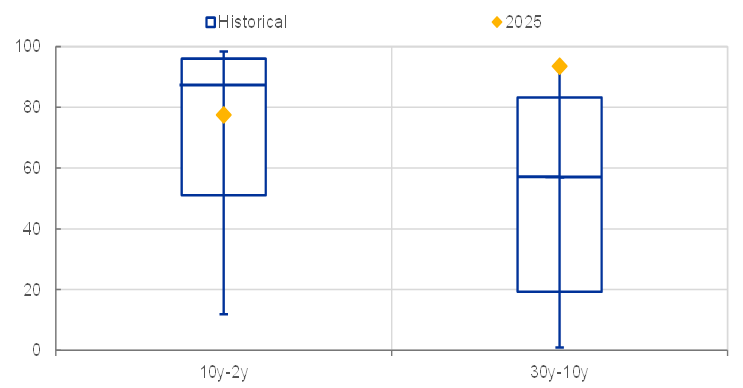
Notes: The chart is based on principal component analyses that, for each curve segment and calendar year, use as input the respective risk-free (i.e. OIS) curve slopes for the euro area, United States, United Kingdom and Japan, normalised in the form of z-scores. The box plots show the minimum, 25th, 50th, 75th percentiles and maximum of the share of variance of euro area risk-free curve slopes explained by the first principal component in the 2013 to 2025 calendar years (“Historical”). Diamonds denote the same explained share in 2025.
This is the outcome of a statistical analysis of the variation in the two- to ten-year and ten- to 30-year curve slopes in the euro area. The analysis looks at the share of this variation that is explained by a common component across major advanced economies, both historically and in 2025. Chart 3 shows that historically this share has never been zero. In other words, there is always some “glue” holding interest rates together globally. But in 2025 this glue bound extraordinarily strongly in the ten- to 30-year, or very long, segment of the curve.
Does this mean, though, that markets have tarred the euro area with the same brush as other major economies?
It seems not. If markets had not paid attention to euro area-specific circumstances, one should expect to find only small differences in the steepening of sovereign bond yield curves across individual euro area countries. Or at least one should not be able to link any differences to plausible economic drivers.
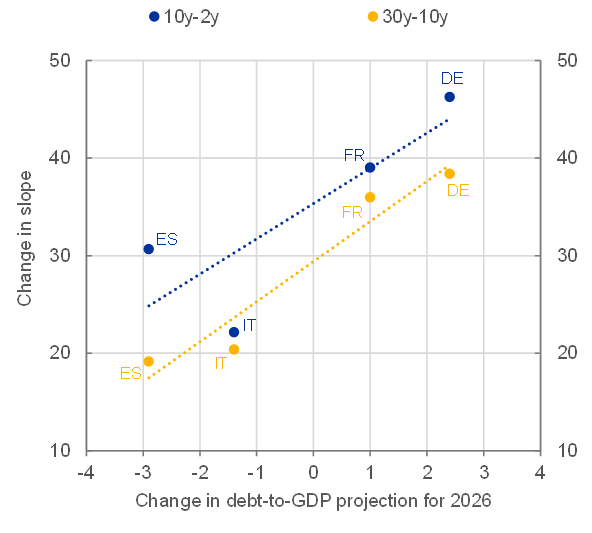
However, sovereign curves in the euro area did not steepen uniformly in 2025. As a case in point, Chart 4 shows that curves steepened visibly more in Germany and France than in Italy or Spain.
Chart 4
Changes in sovereign curve slopes and debt outlook for key euro area countries in 2025
(horizontal axis: percentage points; vertical axis: basis points)
Sources: Bloomberg, LSEG, European Commission and ECB calculations.
Notes: The chart shows year-to-date changes in the 30y-10y and 10y-2y slopes for the big four euro area sovereign curves and changes in their respective debt outlook. These changes are based on debt-to-GDP projections for the year 2026 by the European Commission in its Autumn 2024 and Autumn 2025 Economic Forecasts.
What is more, changes in borrowing costs aligned with changes in the respective debt outlook over the course of 2025. Germany and France, whose debt outlook worsened, saw their borrowing costs increase by more than Italy or Spain, whose debt outlook developed more favourably. Importantly, this observation holds for both the two- to ten-year and ten- to 30-year segments of the curve.
So, while global factors are indeed extraordinarily relevant in explaining the steepening of euro area yield curves in 2025, they are only part of the story.
The views expressed in each blog entry are those of the author(s) and do not necessarily represent the views of the European Central Bank and the Eurosystem.
Check out The ECB Blog and subscribe for future posts.
For topics relating to banking supervision, why not have a look at The Supervision Blog?
This risk-free curve is based on interest rates on overnight index swap (OIS) contracts that use the euro short-term rate (€STR) as their underlying benchmark. See ECB (2014), “Euro area risk-free interest rates: Measurement issues, recent developments and relevance to monetary policy”, July, on the concept of risk-free rates, and Lane, P.R. (2021), “The compass of monetary policy: favourable financing conditions”, 25 February, on their role in the transmission of euro area monetary policy.
Note that the short end, captured here by the two-year maturity, is different from the very short end of the curve – say, at the three-month maturity. Three-month rates decreased by around 70 basis points, largely as a reflection of cuts in the ECB’s deposit facility rate in the first half of 2025. However, two-year rates remained broadly unchanged as the ECB’s policy rate easing was broadly anticipated at the start of the year.