




Boosting efficiency in public investment in times of fiscal constraint
Published as part of the ECB Economic Bulletin, Issue 2/2026.
1 Introduction
The European Union (EU) is faced with massive strategic public investment needs in an environment of limited fiscal space. Europe will have to scale up its strategic investments, especially in the fields of digitalisation, infrastructure, climate change and defence. While the private sector is expected to play a crucial role in financing these needs, the public sector will also have to step up its investments, especially given the leading role it plays in certain domains, such as infrastructure and defence. These strategic investment needs coincide with limited fiscal space, given that public debt and deficit levels are high in many EU counties, most notably in some large euro area countries, and that public spending linked to ageing populations is rising. Governments have had to intervene to stabilise the economy following repeated shocks, but some of them have also failed to make use of good economic times to build up fiscal buffers. As a result, they are now faced with significant fiscal adjustment requirements.
Making public spending more efficient – including in the realm of public investment – can play a pivotal role in easing the pressure on public finances associated with rising strategic investment needs. By making better use of available resources, higher spending efficiency can free up fiscal space, which can be used for more growth-enhancing public investment, and build up buffers to safeguard fiscal sustainability. Two complementary dimensions of efficiency are key in this context: technical efficiency, which focuses on either maximising output from a given set of resources or minimising input to achieve a given output, and allocative efficiency, which ensures that government expenditure prioritises items that promote economic growth.[1] Most empirical studies measuring the efficiency of public spending focus on technical efficiency.[2] In view of the substantial rise in strategic investment needs, allocative efficiency is expected to gain relevance. By redirecting public resources from current expenditure towards strategic investment, such as R&D in defence and the modernisation of public infrastructure, the composition of public spending would shift towards more productive spending, supporting potential growth. However, the scope for raising allocative efficiency is often limited in the short term, owing to the budgetary rigidity that results from legal obligations such as state pensions and public sector wages.[3]
Focusing on public investment in transport infrastructure as an example, empirical results point to substantial room for efficiency improvement. Given that transport infrastructure is the largest component of public investment in the EU, this article looks at the technical efficiency of spending in this particular category. It is taken as an example to illustrate potential room for efficiency improvements, although the results may not necessarily be representative for the whole economy. This emphasis on transport infrastructure is also driven by the fact that a recent Eurobarometer survey indicates that around half of EU citizens see room for better quality public investment in this area.
The article is structured as follows: Section 2 takes stock of public investment in the EU, comparing it with other advanced economies and analysing the macroeconomic effects of productive investment (Box 1). Section 3 looks at strategic investment needs in the EU and explores why many countries are facing fiscal space constraints. Section 4 provides an empirical analysis of the scope of higher efficiency in public investment spending, focusing on infrastructure investment as an example. Section 5 concludes.
2 Stocktaking public investment in the EU
Public investment accounts for around one-sixth of total investment in the EU, although there are significant differences between countries. Across EU Member States, public investment as a share of total investment averaged 17% in 2024, ranging from almost 30% in Luxembourg to around 13% in Belgium (Chart 1). The EU average share is broadly in line with that observed in other advanced economies such as the United Kingdom, the United States and Japan. The share of public investment increased in 22 out of 27 EU countries between 2019 and 2024, driven in part by projects financed under the Next Generation EU (NGEU) programme.[4]
Chart 1
Public and private investment as a share of total investment
(percentages, 2024)

Sources: European Commission and ECB staff calculations.
Notes: The public investment share is defined as gross fixed capital formation by the government as a proportion of total investment (government, business and household sectors, including non-profit institutions serving households). For Ireland, the share of US investment in intellectual property products is excluded from the investment total.
Public investment spending as a share of GDP has increased since 2019. It is expected to average 3.8% of GDP across the EU in 2025, up from 3.1% in 2019 (Chart 2). This is broadly comparable to the share observed in other advanced economies, including Japan, the United States and the United Kingdom. Within the EU, public investment ratios for 2025 are expected to range from 7.3% of GDP in Latvia to 2.9% of GDP in Spain. The largest rises since 2019 are expected to be recorded for Romania, Latvia and Greece. Looking ahead, this increase is forecast to continue, with public investment projected to average around 4% of GDP across EU countries in 2027, according to European Commission’s Autumn 2025 projections.
Chart 2
Public investment as a share of GDP
(percentages)

Sources: European Commission, OECD and ECB staff calculations.
Notes: Public investment is defined as gross fixed capital formation by the government measured as a share of GDP. For Ireland, the ratio is calculated in relation to the modified Gross National Income (GNI*). The figures for 2025 and 2027 are projections from the European Commission’s Autumn 2025 forecast vintage.
The composition of public investment in the EU differs markedly from that in the United Kingdom, the United States and Japan and varies across EU countries. Investment in economic affairs is the most important single item in all countries, with Japan having the highest ratio (Chart 3, panel a). Spending on transport infrastructure, covering assets such as roads and railways, is at a similar level across economic areas. In the EU, it is the largest component, accounting on average for 27% of public investment, which corresponds to 0.9% of GDP in 2023. The shares of public investment in transport infrastructure are highest in Slovakia, Poland and Greece and lowest in France and Cyprus (Chart 3, panel b). General public services is the second largest single investment category in the EU, but defence dominates investment priorities in both the United Kingdom and the United States (Chart 3, panel a). By contrast, education is the second largest area of investment in Japan and the third largest in the United States and the United Kingdom.
Chart 3
Public investment in 2023, by economic function
a) Public investment in the EU, United Kingdom, United States and Japan, by category
(percentage of public investment)

b) Public investment in EU countries, by category
(left-hand scale: percentage of total public investment; right-hand scale: total public investment as a percentage of GDP)

Sources: Eurostat (EU countries), OECD (non-EU countries) and ECB staff calculations.
Notes: The data shown are based on the Classification of the Functions of Government (COFOG). The negative amount shown for “Defence” in Slovakia in panel b) represents a net disposal of fixed assets in the context of foreign military aid in kind to Ukraine (shown as capital transfers and neutral on total expenditure on defence). For Ireland, the ratio is calculated in relation to GNI*.
Public investment is usually found to have a positive effect on economic growth. This is particularly the case if it creates public capital that is complementary to private capital or that would otherwise be undersupplied in an economy. Typical examples are investment in education, health, defence and transport infrastructure. The positive impact on the economy is particularly pronounced if public investment crowds-in private investment, while delayed implementation or funding via distortive taxes could limit the stimulus obtained.[5] Moreover, the composition of public investment matters. While defence spending is often regarded as less supportive of long-term growth, positive spillovers may emerge if the spending is tilted towards productive investment, such as research and development (R&D) in defence.[6] In fact, a model-based analysis of the macroeconomic impact of Germany’s recent defence and infrastructure package underscores the critical role that shifting the composition of public spending towards productive public investment plays in driving economic outcomes (Box 1).
Box 1
Medium-term macroeconomic effects of increased public spending and its composition – the case of Germany
Shifting the composition of public spending towards productive investment can have significant positive macroeconomic effects. An illustrative example is the March 2025 reform of Germany’s debt brake. This move has created fiscal space for strategic investment in defence and infrastructure by introducing two structural changes: (i) a €500 billion special fund, outside of the debt brake rule, to finance civil infrastructure and climate projects over a 12-year horizon; and (ii) a constitutional exemption of defence and security expenditure above 1% of GDP from the debt brake ceiling. Together, these measures are expected to lead to a lasting expansion of public investment.
The model used here to assess the macroeconomic effects of the expected fiscal stimulus for Germany is an extension of the New Area-Wide Model.[7] Accordingly, the results reported below are model dependent and should not be interpreted as predictions. The simulations assume that government expenditure will increase by around 0.9% of GDP by 2027. Thereafter, infrastructure spending from the special fund is kept constant at its 2027 level. Defence spending is assumed to rise from around 2% of GDP in 2025 to 3.5% of GDP by 2029. Overall, this corresponds to a fiscal loosening of about 1.8% of GDP by 2029, with the subsequent composition broadly balanced between consumption and investment. We assume that the increase is quasi permanent and fully debt financed. In scenario 1, all public investment is assumed to be productive by raising the public capital stock. In scenario 2, only infrastructure investment is considered productive. This scenario aims to provide a sensitivity analysis in view of mixed evidence from the literature regarding the military spending multiplier and the finding of heterogeneity in the effects of various components of military expenditure.[8] Government consumption is assumed to enter private household utility as a complement to private consumption.[9]
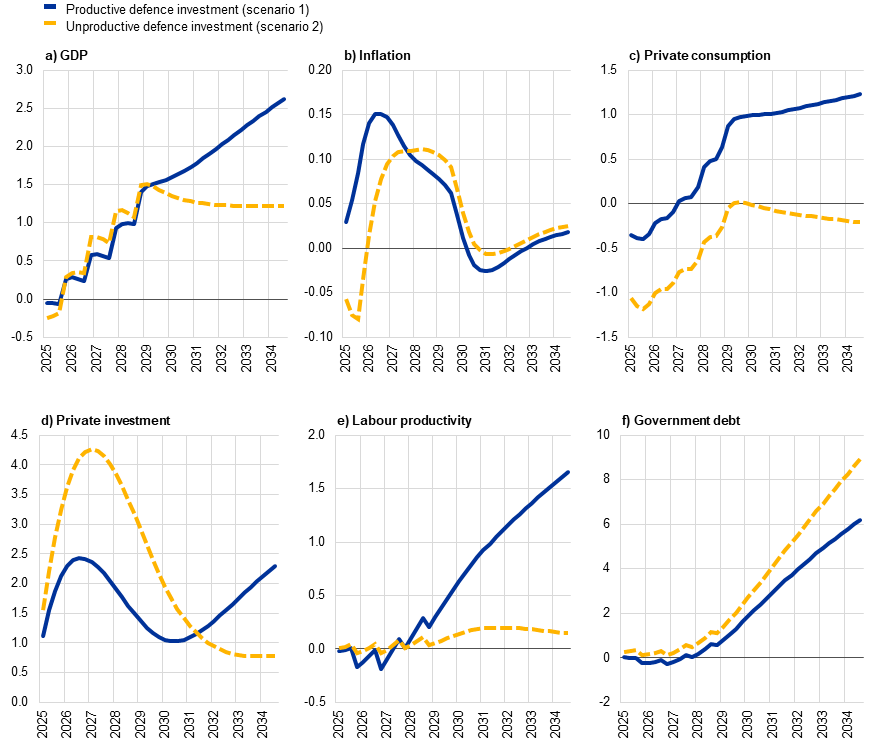
When all public investment is assumed to be productive (scenario 1), Germany experiences a strong and lasting expansion. The permanent step-up in spending lifts actual GDP persistently compared with the baseline (Chart A). Demand effects dominate early on, while public investment raises the capital stock over time and boosts labour productivity. The private consumption response is negative at first but turns positive by 2027. This trajectory reflects offsetting channels: unconstrained households reduce spending as expected persistently higher real interest rates stimulate a return to saving. However, this effect is cushioned by a number of factors: the assumed complementarity between public and private consumption, the increase of liquidity-constrained household consumption in response to their higher disposable income resulting from higher employment, and the expansion of the economy’s productive capacity due to the increase in government investment, which raises the permanent income of all households. Private investment rises sharply as firms respond to both expected higher sustained demand and improved productivity. As a result, the ten-year cumulative multiplier of the package equals approximately one.[10] Inflation increases, and monetary policy reacts by raising nominal policy rates. There is a sharp increase in the government debt ratio, reflecting both the higher expenditure and the persistent rise in real rates.
When military investment is assumed to be unproductive (scenario 2), German GDP has a similar short-run trajectory, but expands much less in the long run. Private consumption remains weaker, as the permanent-income channel is diminished and higher real rates are not offset by supply-side improvements. As a result of a smaller rise in euro area-wide inflation compared with scenario 1, monetary tightening is delayed and smaller. This means that private investment increases more initially, but eventually drops below the trajectory in scenario 1. The smaller improvement in economic activity implies a larger increase in the public debt ratio than in scenario 1.
Chart A
Macroeconomic effects of increased defence and infrastructure expenditure in Germany
(percentage and percentage-point deviations)
Source: ECB staff calculations.
Notes: Responses are in percentage deviations from the baseline, except inflation and government debt, which are in percentage-point deviations. Government debt is expressed as a share of GDP.
3 Limited fiscal space
EU countries need to significantly scale up their strategic investment spending to effectively navigate an increasingly competitive and digitalised world, while addressing mounting geopolitical and climate-related risks. Besides heightened pressure to allocate more public spending to defence, the green and digital transitions as well as infrastructure will still demand substantial additional investment activity. Although the private sector is expected to play a crucial role in financing the additional needs, the burden on governments will increase considerably. According to Bouabdallah et al. (2025), public funding requirements for defence and the green and digital transitions are projected to reach approximately €510 billion annually.[11]
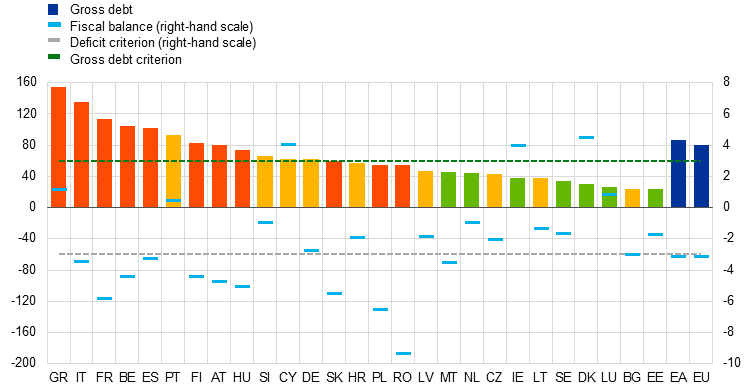
These major public investment needs have arisen in an environment of high debt and deficit levels in many EU Member States. The aggregate public debt-to-GDP ratio of the EU stood at 80.7% in 2024, more than 3 percentage points higher than before the pandemic. This masks considerable differences across Member States, with debt ratios ranging from 23.5% of GDP in Estonia to 154.2% of GDP in Greece (Chart 4). In addition, almost half of EU Member States had deficit-to-GDP ratios exceeding the 3% threshold.[12]
Chart 4
Gross government debt and fiscal balance in the EU
(2024, percentages of GDP)
Source: Eurostat.
Notes: The colour coding of the Member States is based on the overall medium-term risk category of the European Commission’s Debt Sustainability Monitor 2024 (European Commission, 2025a). Red, yellow and green bars signify high, medium and low risks to medium-term debt sustainability respectively. The dashed lines indicate the thresholds for the debt and deficit criteria.
Many Member States will need to deliver sizeable fiscal adjustments to ensure the sustainability and credibility of their public finances and comply with the requirements of the reformed EU governance framework. From 2025 to 2028, the majority of EU Member States will have to deliver average fiscal adjustments, in terms of changes in their structural primary balances, ranging from 0.1 to 1.5 percentage points of potential GDP (Chart 5).[13]
Chart 5
Average changes in structural primary balances
(2025-28, percentage points of potential GDP)

Source: European Commission.
Notes: Based on medium-term fiscal-structural plans as published on the European Commission’s website. For Romania and Finland, the fiscal adjustments presented are those included in the Council Recommendations related to the excessive deficit procedure. For the Netherlands, the fiscal adjustment figure is taken from the Commission. The average changes in the structural primary balances account for the lower fiscal adjustment requirements of the Member States which requested an extension of the adjustment period. The colour coding of the Member States is based on the overall medium-term risk category of the European Commission’s Debt Sustainability Monitor 2024 (European Commission, 2025a). Red, yellow and green signify high, medium and low risks to medium-term debt sustainability respectively.
The flexibility provided by the reformed governance framework only partly caters for strategic investment needs. The EU’s new economic governance framework builds on the premise that countries are allowed to extend their adjustment period from four to seven years in exchange for government investment and reforms. With eight EU Member States requesting an extension of the adjustment period, this provides fiscal space of around 5.0 percentage points of potential GDP over the 2025-28 period. Moreover, activating the national escape clause offers temporary budgetary flexibility to increase defence spending by up to 1.5% of GDP annually over the same period.[14] In aggregate, such flexibility would allow Member States to cover only around a third of the estimated €510 billion in public strategic investment needs. When already existing EU resources are included, such as the funds available under the NGEU programme, a public funding gap of over €100 billion per year would need to be borne by national budgets.[15] In this context, raising the spending efficiency of public investment is critical, as this could help to better balance spending needs and fiscal constraint.
4 Scope for higher technical efficiency in public investment
Different empirical tools can be applied to measure the technical efficiency of public investment. The two most widely used methodologies for measuring efficiency are the data envelopment analysis (DEA) and the stochastic frontier analysis (SFA). They allow the fiscal policies of countries to be benchmarked against an efficiency frontier based on best performers. The DEA is a non-parametric methodology that constructs an efficiency frontier directly from observed data by comparing the relative performance of each country.[16] However, the DEA is highly sensitive to the underlying data and outliers. A bootstrapped DEA partially addresses this issue by resampling the data and generating multiple efficiency frontiers, helping identify over-performing countries and correcting the bias. The SFA, by contrast, is a parametric approach that assumes a specific production function for estimating an efficiency frontier.[17] The advantage of the SFA lies in its ability to decompose the error term into two components: inefficiency and statistical noise. This makes it possible to control for external factors that influence the output variable, such as, for example, urbanisation affecting the density of a public transport network. Furthermore, the SFA supports the use of country fixed effects, making it possible to control for heterogeneity across countries. However, its primary limitation is the need for at least partial parameterisation and the assumption of proportionality of the input and output variables for the production function, which can result in an incorrectly specified efficiency frontier. Another notable distinction between the two methodologies is their treatment of time: the DEA provides a snapshot of efficiency at a single point in time, while the SFA, applied to panel data, generates efficiency scores over time.
Here, we apply the DEA and SFA methodologies to assess the technical efficiency of public investment in transport infrastructure in the EU. As mentioned in Section 2, public investment in transport infrastructure accounts for more than a quarter of total public investment in the EU, which corresponds to 0.9% of GDP in 2023. For the DEA, two indicators are used as output measures: the density of the transport network and a World Bank indicator assessing the quality of public transport infrastructure. For the SFA, the density of the transport network is analysed as the output measure separately for railway and motorway networks.[18] The analysis carried out using both methodologies is based on an input-oriented approach. The aim of using this approach is to measure the amount by which the resources spent can be minimised to achieve a given output. Boosting efficiency would create fiscal space which could be used either for other strategic investment needs or to build up fiscal buffers.
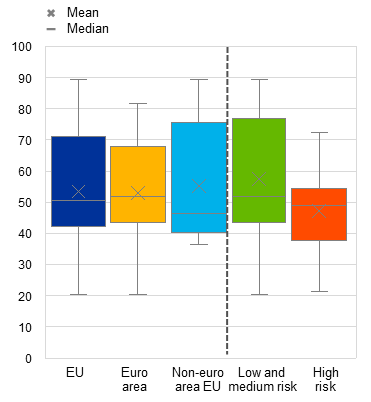
The results reveal that there is significant room for improving investment efficiency, although this is not evenly spread across country groups. Based on the DEA model, the median efficiency score of public investment in transport infrastructure, measured vis-à-vis transport network density, is around 50% for the EU and the euro area (Chart 6, panel a).[19] This means that the current efficiency level with public transport investment as input is only half of the efficiency frontier. Based on the median estimates, efficiency is slightly lower in the non-euro area EU countries. The results are broadly comparable to other studies, despite differences in data and country coverage.[20] Heterogeneity in the efficiency of transport investment across countries (as captured by the length of the box plots) appears to be higher in the non-euro area EU countries than in the euro area countries. Interestingly, efficiency is found to be moderately lower on average in countries with constrained fiscal space, as proxied by a high debt sustainability risk grouping in the European Commission’s medium-term Debt Sustainability Monitor (shown by the red box plots).[21] This suggests that the high-risk countries have slightly more scope to alleviate projected fiscal pressures by improving the efficiency of public investment in transport infrastructure. This holds in particular when accounting for the large heterogeneity across countries, as the efficiency score is particularly high in some of the low-risk countries. Thus, boosting efficiency by minimising the resources required for a given output could be particularly beneficial for high-risk countries with limited fiscal space.
An alternative proxy of efficiency can be derived from survey results assessing the quality of public transport investment. When public transport investment is inferred on public transport quality as measured by World Bank survey data, the resulting efficiency scores are slightly better (Chart 6, panel b).[22] The median EU average efficiency score is around 65%, whereas non-euro area countries tend to score noticeably lower.[23] The variation in the efficiency score is more pronounced among high-risk countries, whereas their median scores remain lower than those of low-risk countries. These results broadly coincide with a recent Eurobarometer survey, which indicates that 51% of EU citizens would welcome more public investment to boost the frequency of urban public transport, while 42% see a need for better commuting options. However, the results obtained through the DEA should be interpreted with caution, as they are derived solely from the underlying data without accounting for the influence of external factors on efficiency.
Chart 6
Efficiency in public transport infrastructure investment – data envelopment analysis
a) Transport network density | b) Public transport quality indicator |
|---|---|
(percentages, 2023) | (percentages, 2024) |
 |  |
Sources: Eurostat, World Bank and ECB staff calculations.
Notes: The analysis is based on a bootstrapped DEA with 2,000 draws to correct the bias from the standard DEA model, following the methodology of Simar and Wilson (1998). COFOG transport investment as a share of GDP is taken as input with one lag and as a five-year moving average. The output variable in panel a) is railway and motorway density, which is combined into a single indicator for 2023 using principal component analysis. In panel b), the output variable is the World Bank quality indicator for public transport, rating its quality with a score between 1 and 7 for 2024. Panel a) covers 26 EU countries and panel b) 23 EU countries. The bar indicates the interquartile range and the error bar the maximum and minimum of the range of the country sample belonging to each group. The high-risk and low/medium-risk grouping is based on the debt sustainability analysis carried out by the European Commission (European Commission, 2025a) for the EU countries covered in the sample.
When the SFA methodology is applied, the technical efficiency scores show somewhat lower results and vary across transport components. When looking at individual components of transport infrastructure investment – railways and motorways – efficiency differs widely across country groups and time (Chart 7). In particular, the median efficiency score for public investment in railways is lower than that for motorways, with the EU average standing at 38% for railway and 43% for motorway spending. Only for the euro area is the median efficiency of investment in railways higher than in motorways, while it is lowest in the non-euro area EU countries, high-risk countries and countries outside the EU. The results show large variation over time in the efficiency of public investment in motorways in most country groups (as captured by the length of the box plots). The pronounced variations over time may also reflect non-linear effects, given the large amounts of time needed to complete large infrastructure projects.[24] Broadly, the results obtained through the SFA align with those derived from the DEA, despite differences in input variables, the time period covered, country samples and methodology. The analysis reveals that for both methodologies used, technical efficiency in transport infrastructure investment across the EU appears to be relatively low, also compared with other areas of public investment such as health and education.[25]
These findings are affected by country-specific factors, some of which can be addressed through policy changes. Geography and population density may increase the complexity and cost of infrastructure projects, thereby potentially leading to lower efficiency scores for some countries compared with their peers.[26] Moreover, rigid regulatory requirements, poor project management and governance and limited administrative capacity can drive up costs and reduce efficiency. Addressing these factors can help make complex transport infrastructure projects more manageable, leading to lower costs and higher efficiency scores. While not covered in this analysis, it would be valuable to examine how these potential factors might be contributing to the results.
Chart 7
Efficiency in railway and motorway investment – stochastic frontier analysis
(percentages, 2000-23 average)

Sources: Eurostat, OECD and ECB staff calculations.
Notes: As input, the maintenance and investment spending of countries reported in OECD data are combined to form a single indicator, then used with one lag and as a five-year average. As output, the length of the railway and motorway network is divided by the land area, sourced from Eurostat. The analysis is conducted with an SFA using country fixed effects to account for country heterogeneity, showing highly significant results below the 1% level. For robustness, the SFA is repeated while assuming heteroscedasticity of the error terms, incorporating control variables such as freight moved, country altitude, urbanisation and GDP per capita. This robustness analysis is restricted to EU countries owing to data limitations. The results remain highly significant and broadly unchanged after adding these controls. Additionally, the results are confirmed by using a DEA. In the OECD database, only 14 EU countries reported data on motorway spending, and only 17 EU countries reported data on rail spending. The total sample consists of 17 countries for motorway spending including the United Kingdom, Switzerland and Türkiye and 25 countries for rail spending including Canada, China, India, Norway, Switzerland, Türkiye, the United Kingdom and the United States. Due to missing data over the full period, the sample is not homogeneous across time, which is why time heterogeneity, not country heterogeneity, is displayed using a boxplot. Therefore, the boxplot illustrates the time dimension, i.e. the range of time averages for each country grouping over the 2000-23 period. The maximum and minimum bars represent the highest and lowest country group averages at a given point in time. The high-risk and low/medium-risk grouping is based on the debt sustainability analysis carried out by the European Commission (European Commission, 2025a) for the EU countries covered in the sample.
Closing the efficiency gap would help save public money. The efficiency gap measures the distance from the hypothetical case of full efficiency. It gives a rough indication of the maximum savings that could be achieved through higher technical efficiency. Applied to the analysis above, the efficiency gap measures the maximum possible savings that could be achieved by reducing the amount spent on transport infrastructure investment to obtain the same level of output. For the EU, the potential savings from closing the efficiency gap are estimated to approximately range between €46 billion and €50 billion in a particular year for the two indicators used in the DEA.[27] However, the results regarding the possible savings should be interpreted with caution for several reasons. First, the results are sensitive to the variables and methodology used to calculate the efficiency gap.[28] Second, the results are driven by the country coverage, which limits their comparability. Third, in particular for large infrastructure projects running over many years, the relationship between investment and outcome appears to be non-linear. In the analysis, this could be only partly addressed by using lagged multiple yearly averages. Fourth, the savings to be made by raising efficiency would only be realised with a delay, as they would apply to future investments. Finally, the savings are unlikely to be recurrent and should rather be seen as a snapshot. To the extent that higher efficiency is achieved through streamlining and better management of infrastructure projects, these would have a permanent impact, thereby reducing the potential need for further efficiency savings.
5 Conclusions
The analysis shows that there is a significant technical efficiency gap in public transport investment across the EU. Focusing on public investment in transport infrastructure – the largest component of public investment in the EU – the empirical analysis suggests considerable potential for savings through higher efficiency, ranging from €46 billion to €50 billion, although these figures entail high uncertainty. The efficiency scores for transport infrastructure investment seem to be considerably lower when compared with the findings in the literature with respect to spending on health and education in the EU. Indeed, infrastructure projects tend to be larger and more complex, which makes them more prone to inefficiencies. If combined with a stronger prioritisation of government spending on more productive investment, which is expected to be growth-enhancing, higher efficiency would help to free up fiscal space for strategic investment and contain fiscal sustainability risks.
Better project management and governance practices can increase the efficiency of public investment.[29] Adopting a public investment management framework can help to identify areas in need of improvement. These frameworks also facilitate cross-country comparisons and the benchmarking of best practices. Various institutions, such as the International Monetary Fund, the European Commission, the World Bank and the Organisation for Economic Co-operation and Development, have developed such frameworks which can be used to examine national governance practices for the entities tasked with managing public investment.[30] Specifically, they assess institutional design – such as institutional strength and fiscal rules – and actual effectiveness, measured by the extent to which the intended purpose is being achieved. For EU countries, recent assessments point to room for improvement; this includes ensuring quality assurance is carried out at the preparatory stage of investment projects, integrating planning and budgeting cycles and making sure investment planning has a stronger fiscal sustainability angle.[31]
Closing the efficiency gap requires a targeted set of policy measures to facilitate public investment. Such policy measures, which are likely to differ across countries, range from reducing red tape to streamlining regulatory reporting requirements. Countries also seem to have room to improve their administrative capacity, streamline governance structures to manage complex investment projects, such as for transport infrastructure, and eliminate corruption. Spending reviews can help prioritise public spending and identify areas for additional savings. Several EU countries, such as Denmark, Spain and the Netherlands, regularly conduct such spending reviews.[32] While a detailed assessment of the necessary national measures lies beyond the scope of this article, addressing inefficiencies calls for an in-depth analysis of the underlying drivers. As these vary significantly across countries, some of the appropriate policy responses will need to be country-specific. Therefore, it is important for the necessary adjustments to be adequately reflected in the policy guidance and follow-up under the European Semester, which coordinates economic policies in the EU.[33]
References
Abiad, A., Furceri, D. and Topalova, P. (2016), “The macroeconomic effects of public investment: Evidence from advanced economies”, Journal of Macroeconomics, Vol. 50, pp. 224-240.
Afonso, A., Alves, J. and Bazah, N. (2024), “Public Sector Efficiency and the Functions of the Government”, REM Working Papers, No 357, ISEG − Lisbon School of Economics and Management, November.
Antolin-Diaz, J. and Surico, P. (2025), “The Long-Run Effects of Government Spending”, American Economic Review, Vol. 115, No 7, pp. 2376-2413.
Barnes, S., Cournède, B. and Hanmer, F. (2025), “Assessing government spending in OECD countries and searching for savings”, OECD Economics Department Working Papers, No 1845, OECD Publishing.
Bokan, N., Jacquinot, P., Lalik, M., Müller, G., Priftis, R. and Rigato, R. (2025), “Macroeconomic impacts of higher defence spending: a model-based assessment”, Economic Bulletin, Issue 6, ECB.
Bouabdallah, O., Dorrucci, E., Nerlich, C., Nickel, C. and Vlad, A. (2025), “Time to be strategic: how public money could power Europe’s green, digital and defence transitions”, The ECB Blog, ECB, 25 July.
Bouakez, H. and Rebei, N. (2007), “Why does private consumption rise after a government spending shock?”, The Canadian Journal of Economics/Revue canadienne d’Economique, Vol. 40, No 3, pp. 954-979.
Canzonieri, G. and Giamboni, L. (2024), “Efficiency of Public Expenditure in Education and Health”, Discussion Papers, No 217, European Commission, December.
Clancy, D., Jacquinot, P. and Lozej, M. (2016), “Government expenditure composition and fiscal policy spillovers in small open economies within a monetary union”, Journal of Macroeconomics, Vol. 48, pp. 305-326.
Coenen, G., Lozej, M. and Priftis, R. (2024), “Macroeconomic effects of carbon transition policies: An assessment based on the ECB’s New Area-Wide Model with a disaggregated energy sector”, European Economic Review, Vol. 167, pp. 1047-1098.
Coenen, G., McAdam, P. and Straub, R. (2008), “Tax reform and labour-market performance in the euro area: A simulation-based analysis using the New Area-Wide Model”, Journal of Economic Dynamics and Control, Vol. 32, No 8, pp. 2543-2583.
Coenen, G., Straub, R. and Trabandt, M. (2012), “Fiscal Policy and the Great Recession in the Euro Area”, American Economic Review, Vol. 102, No 3, pp. 71-76.
Eurobarometer (2025), Public opinion on urban challenges and investment in cities, European Commission, June.
European Central Bank (ECB) (2016), “Public investment in Europe”, Economic Bulletin, Issue 2, ECB.
European Commission (2025a), “Debt Sustainability Monitor 2024”, Institutional Papers, No 306, March.
European Commission (2025b), 2026 European Semester: Autumn package – communication, 25 November.
Greene, W. (2005), “Reconsidering heterogeneity in panel data estimators of the stochastic frontier model”, Journal of Econometrics, No 126, Issue 2, pp. 269-303.
Haroutunian, S., Bańkowski, K., Bischl, S., Bouabdallah, O., Hauptmeier, S., Leiner-Killinger, N., O’Connell, M., Arruga Oleaga, I., Laurent, A. and Trzcinska, A. (2024), “The path to the reformed EU fiscal framework: a monetary policy perspective”, Occasional Paper Series, No 349, ECB, May.
Herrera, S., Isaka, H. and Ouedraogo, A. (2025), “Efficiency of public spending in education, health, and infrastructure: an international benchmarking exercise”, Journal of Applied Economics, Vol. 28, Issue 1.
Hoogeland, M., Dimitriadis, L. and Mandl, M. (2024), “How Have Spending Reviews Recently Evolved Through EU Initiatives?”, Discussion Papers, No 200, European Commission, May.
Ilzetzki, E. (2025), “Guns and Growth: The Economic Consequences of Defense Buildups”, Kiel Report, No 2, Kiel Institute for the World Economy.
IMF (2025), “Spending Smarter: How Efficient and Well-Allocated Public Spending Can Boost Economic Growth”, Fiscal Monitor, Chapter 1, October.
Kapsoli, J., Mogues, T. and Verdier, G. (2023), “Benchmarking Infrastructure Using Public Investment Efficiency Frontiers”, IMF Working Papers, No 2023/101, International Monetary Fund.
Leeper, E.M., Walker, T.D. and Yang, S.-C.S. (2009), “Government Investment and Fiscal Stimulus in the Short and Long Runs”, Working Papers, No 15153, National Bureau of Economic Research.
Manescu, C. (2026), “Public investment management practices in the EU: A comparative analysis based on the 2025 Commission survey”, Discussion Papers, European Commission, forthcoming.
Moretti, E., Steinwender, C. and Van Reenen, J. (2025), “The Intellectual Spoils of War? Defense R&D, Productivity, and International Spillovers”, The Review of Economics and Statistics, Vol. 107, Issue 1, January, pp. 14-27.
Ramey, V.A. (2020), “The macroeconomic consequences of infrastructure investment”, Working Paper, No 27625, National Bureau of Economic Research.
Simar, L. and Wilson, P. (1998), “Sensitivity Analysis of Efficiency Scores: How to Bootstrap in Nonparametric Frontier Models”, Management Science, Vol. 44, Issue 1, pp. 49-61.
See, for example, IMF (2025).
See, for example, Kapsoli et al. (2023), Afonso et al. (2024), Herrera et al. (2025) and Canzonieri and Giamboni (2024). In a recent paper by Barnes et al. (2025), the focus is specifically on allocative efficiency to identify potential savings.
On average, close to 50% of public spending in the EU is tied to payments for pensions, public sector wages and interest, which are very challenging to adjust in the short term. While this is a very rough proxy for the rigidity of public spending, more comprehensive estimates of rigidity can be found in IMF (2025).
Public investment financed under the NGEU is gradually increasing, accounting for around 5% of total public investment in the EU in 2024.
See, for example, European Central Bank (ECB, 2016), Ramey (2022), Leeper et al. (2009) and Abiad et al. (2016).
See Moretti et al. (2025) and Antolin-Diaz and Surico (2025).
This box employs a version that consists of Germany and a residual “rest of the euro area” aggregate. For details on the original version of the model, see Coenen et al. (2024) and Coenen et al. (2008).
For an analysis of the macroeconomic impact of higher government defence spending using a suite of models, see Bokan et al. (2025). It suggests an average output multiplier of government spending across models of 0.93 over a two-year horizon while pointing to substantial heterogeneity across models.
This assumption follows Bouakez and Rebei (2007), Leeper et al. (2009) and Coenen et al. (2012). The degree of complementarity, as measured by the elasticity of substitution between private and public consumption, is set to 0.3, in line with the values reported in Bouakez and Rebei (2007) and Coenen et al. (2012), who estimate this parameter jointly with the other parameters of their respective DSGE models. Clancy et al. (2016) assume even stronger complementarity.
The ten-year cumulative multiplier is defined as the sum of the simulated (absolute) deviations of GDP from its baseline over ten years divided by the deviations of government expenditure over that horizon.
See Bouabdallah et al. (2025). The annual estimate of additional public investment needs over the period from 2025 to 2031 refers to investment in a broader sense than in national account terms, in that it includes, for example, public spending on durable goods. However, the estimates are surrounded by considerable uncertainty. They do not specifically include investment needs in the area of transport infrastructure, beyond what is envisaged under the category of additional defence spending.
Ten EU Member States are currently subject to an excessive deficit procedure.
The reformed governance framework rests on the debt sustainability analysis to guide country-specific fiscal adjustment paths such that government debt is brought onto a plausibly declining path by the end of an adjustment period. This implies differentiation in fiscal adjustment requirements across countries, with higher adjustment requirements where debt challenges are more pronounced and/or where initial budgetary positions are less favourable; see Haroutunian et al. (2024).
Seventeen Member States have so far requested to activate the national escape clause. The temporary nature of this flexibility, however, means that the Member States concerned must commit to stronger fiscal consolidation from 2029 onwards in order to remain compliant with the EU fiscal rules.
See Bouabdallah et al. (2025). The estimated gap of over €100 billion only refers to public investment in digitalisation, climate change and defence. Infrastructure investment is only partly covered under the envisaged additional defence spending.
The DEA accommodates variable returns to scale in constructing the efficiency frontier, i.e. the input and output variables do not need to be proportional. This is in contrast to the SFA, which requires the output variable to be proportional to the input variables.
Some studies also use semi-parametric SFA.
The SFA methodology used is the panel version with fixed effects developed by Greene (2005). In the analysis, geography and population density are accounted for as fixed effects.
Transport network density is defined as the length of built transport network (railways, motorways) divided by the land area.
For example, Kapsoli et al. (2023) find that the median efficiency score in their baseline model (capturing roads, energy and telecommunications), using a bootstrapped DEA, is at 42% in advanced economies, which includes EU countries. Similar results were also found by Herrera et al. (2025).
See European Commission (2025a).
The World Bank’s quality indicator ranges between 1 (lowest quality) and 7 (highest quality).
The results for the quality of public transport are comparable to the findings of Herrera et al. (2025).
For instance, there may be a long period of preparatory expenditure with no change in the output variable followed by a steep increase in output when completion milestones are achieved.
Canzonieri and Giamboni (2024) report EU efficiency scores of above 90% for health and education expenditure. See also Herrera et al. (2025) and IMF (2025).
In the SFA, these country-specific differences are accounted for using fixed effects. Additionally, robustness in the EU sample is ensured by controlling for various other factors, like freight moved, passenger cars per capita and public usage of the rail network, that may influence the efficiency term, with results remaining largely consistent.
The estimates from both output indicators shown in Chart 6 are derived by the sum of the respective DEA efficiency gap (1 minus efficiency score) of each EU country multiplied by the five-year moving average of each country’s public transport investment. Using the SFA approach, the estimated savings would be considerably smaller. Yet the estimated saving gains are not comparable across methodologies owing to a considerably smaller non-homogenous country sample with some of the largest EU countries, such as Germany, missing. In addition, the SFA is focused on rail and motorway investment and maintenance (reported by the OECD), which is a sub-sample of transport investment used in the DEA.
The efficiency scores may be affected by public-private partnerships (PPPs) of infrastructure projects, which are not covered by the analysis, however.
See also IMF (2025).
The IMF’s Public Investment Management Assessment (PIMA) framework was the first of its kind. The European Commission expanded the framework to five key stages (planning, appraisal, selection, budgeting, implementation and ex post reviews) and is conducting regular surveys.
See Manescu (2026). Only a few EU countries have been found to apply good practices in investment planning for major infrastructure projects.
For an overview, see Hoogeland et al. (2024).
See European Commission (2025b).