



Published as part of the ECB Economic Bulletin, Issue 8/2025.
Recent shocks have underscored the importance of and challenges associated with monitoring global trade in a timely manner. The large effects of post-COVID-19 pandemic supply bottlenecks (2021-22), disruptions in the Panama Canal (2023) and the Red Sea (2024-25), and recent tariff escalations have highlighted the need for timely trade monitoring. This box outlines how the inclusion of real-time indicators derived from satellite data on vessel movements in an otherwise standard tracker can provide timely insights into global trade dynamics. The augmented tracker currently indicates subdued but improving trade dynamics.
ECB staff first developed a global trade tracker in 2020 to track world import growth (outside the euro area) using trade-related financial indicators; however, its accuracy was limited.[1] That initial version relied primarily on financial market data such as stock prices for global logistics companies. Following the methodology of Lewis et al. (2022), a principal components analysis was used to extract the underlying trend in an input dataset combining high-frequency (daily and weekly) data with monthly indicators.[2] Despite its timeliness compared with national accounts data, which are not released until 30-45 days after the end of the reference quarter, this version of the tracker exhibited limited out-of-sample accuracy.
New indicators based on vessel movements tracked by satellite offer real-time information on trade by country and commodity. The automatic identification system (AIS) is a tracking system through which ships transmit key information such as identity, position, speed, direction and navigational status (e.g. underway, at anchor) to satellites. Originally developed to prevent collisions, AIS data have become widely used in economics as these are daily data released with just a one-day publication lag. For the purpose of tracking trade, four indices are used: (1) country-level aggregate trade (imports and exports) constructed by counting the volume of cargo arriving at a country’s ports; (2) maritime activity at key chokepoints based on the same method; (3) trade flows for key commodities – oil, liquified natural gas (LNG), iron, coal, bauxite – obtained by tracking tankers and bulk carriers; and (4) automotive exports obtained by tracking roll-on/roll-off ships (vessels dedicated to transporting vehicles).
The satellite-based indicators match key events in global trade well. For example, the surge in goods trade following the pandemic was mirrored by a large uptick in maritime traffic (Chart A, panel a). In the second quarter of 2025, the same data indicated a marked slowdown in US trade amid rising trade barriers and the contrasting resilience of China’s trade. Likewise, the widespread post-pandemic supply bottlenecks were visible in the above-average congestion at major US ports (Chart A, panel b). Another example was the attacks by Houthi rebels on Red Sea shipping in 2024, which prompted shipping companies to reroute vessels via the Cape of Good Hope (Chart A, panel c).
Chart A
Satellite-based trade indicators
a) Seaborne trade
(annual percentage changes, three-month moving averages)

b) Congestion at major ports
(number of days spent in anchorage area)

c) Maritime activity at key chokepoints
(30-day moving averages; index: January to October 2023 = 100)

Sources: QuantCube and ECB staff calculations.
Notes: In panel b), the index is based on container ships at the ports of Los Angeles and Long Beach. The latest observations are for 30 October 2025.
Satellite-based indicators exhibit a stronger correlation with global trade than financial indicators, making them well-suited to augment the trade tracker. Statistical tests (Efron et al., 2004; Fan and Lv, 2008) assessing the predictive power of various daily and weekly indicators relative to global imports show that satellite-based series outperform market-based indicators (e.g. equity prices, shipping prices, commodity prices) and indicators from alternative data sources (e.g. Google Trends, flights data). For instance, some satellite-based indices (e.g. EU auto exports) have a Pearson correlation with global imports higher than 0.7 over the period 2016-24, while financial indicators have an average correlation of 0.4.
The revised global trade tracker incorporates the satellite data with the highest predictive power.[3] The selection follows the literature, which shows that factor models are significantly more accurate when selecting fewer but more informative predictors (Bai and Ng, 2008). The augmented tracker incorporates 47 series, of which 25 are weekly (four equity prices of shipping companies and 21 satellite-based indicators) and 22 are monthly (e.g. the new export orders Purchasing Managers’ Index and customs data). Among country-specific indicators – for 12 countries accounting for 64% of global trade – the selection of data-driven variables reflects the central role of China, with several of the selected indicators being related to Chinese trade (auto exports, overall trade, and imports of LNG, iron and oil).
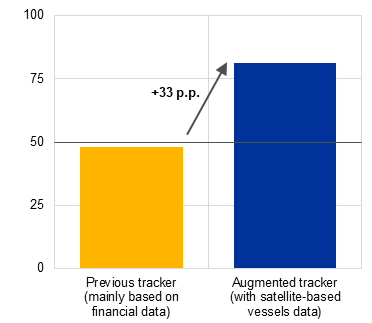
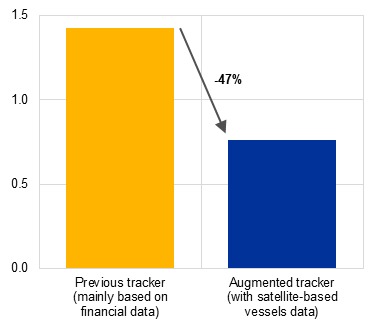
Satellite data substantially improve the forecast performance of the tracker, both in terms of directional accuracy (increased from 50% to 80%) and in terms of point accuracy (out-of-sample error cut by half). The out-of-sample directional forecast accuracy of the previous tracker was below 50%, meaning that it correctly predicted the direction of global trade growth less than half the time. By comparison, the revised tracker would have correctly predicted the direction in around 80% of cases over the period 2021-24 (Chart B, panel a).[4] Similar results are observed for point forecast accuracy, where the out-of-sample root mean squared error (RMSE) is reduced by around 50% (Chart B, panel b).
Chart B
Out-of-sample forecast accuracy
a) Directional accuracy | b) RMSE |
|---|---|
(percentages) | (quarterly percentage changes) |
 |  |
Sources: Bloomberg, S&P Global, Haver, QuantCube and ECB staff calculations.
Notes: Accuracy over the period 2021-24. In panel a), directional accuracy is the proportion of periods where the direction of change in actual global import growth (positive or negative) coincided with the direction predicted by the tracker.
The augmented tracker particularly outperforms the previous tracker in periods when financial market variables diverge from global trade dynamics. Global trade is generally well-correlated with financial market movements (Barhoumi and Ferrara, 2015), but this relationship can lead to erroneous signals when financial markets widely decouple from trade dynamics. This occurred in 2022, when stock markets fell amid surging inflation and geopolitical shocks while global trade was resilient due to the gradual easing of supply bottlenecks (Chart C, panel a). A similar situation arose in the first quarter of 2025, when financial markets retreated due to policy uncertainty whereas global trade was boosted by a frontloading of imports ahead of tariffs (Chart C, panel b). In both episodes, the previous tracker pointed to global trade growth well below its actual pace, which the augmented tracker captured more accurately.
Chart C
Out-of-sample predictions
(three-month-on-three-month percentage changes)
a) Supply bottlenecks | b) Q1 2025 |
|---|---|
 | |
Sources: Bloomberg, S&P Global, Haver, QuantCube and ECB staff calculations.
The augmented tracker currently suggests that global trade remains subdued, albeit improving (Chart D). The augmented tracker indicates that global trade bottomed out in the second quarter of 2025, consistent with the sharp decline in US imports (-8% quarter-on-quarter), and improved in the third quarter. This rebound is in line with recent national accounts releases from China and South Korea showing strong export performance – bolstered in the case of South Korea by surging artificial intelligence (AI)-related shipments which partially offset the drag from tariffs. While the augmented tracker points to below-average trade growth, the previous tracker would have shown a significantly more optimistic picture driven by buoyant financial markets. In the augmented tracker, the new satellite data act to moderate such signals.
Chart D
Global trade tracker
(three-month-on-three-month percentage changes, deviation from 2016-24 average)

Sources: Bloomberg, S&P Global, Haver, QuantCube and ECB staff calculations.
Notes: The chart shows the deviation from the average growth over the period 2016-24 of 0.8%. “Contribution of new data to augmented tracker” is computed as the difference between the previous tracker and the augmented tracker.
The global trade tracker complements other trade forecasting tools, helping to form a top-down assessment of the short-term outlook. The tracker complements dynamic factor models and error-correction-based trade equations to serve as a starting point for trade analysis. It offers a timely pulse check by drawing on high-frequency data, making it more responsive to rapid shifts in trade dynamics than models based on monthly or quarterly data. Nevertheless, the tracker is a complement to rather than a substitute for other tools, as in normal times high-frequency data, which are inherently noisy, might be of second-order importance.
References
Bai, J. and Ng, S. (2008), “Forecasting economic time series using targeted predictors”, Journal of Econometrics, Vol. 146, No 2, October, pp. 304-317.
Barhoumi, K. and Ferrara, L. (2015), “A World Trade Leading Index (WTLI)”, IMF Working Papers, No 2015/020, International Monetary Fund, January.
Delle Chiaie, S. and Perez-Quirós, G. (2020), “Nowcasting economic activity and trade in times of COVID-19: are high frequency data useful?”, unpublished manuscript.
Efron, B., Hastie, T., Johnstone, I. and Tibshirani, R. (2004), “Least angle regression”, The Annals of Statistics, Vol. 32, No 2, April, pp. 407-499.
Fan, J., and Lv, J. (2008), “Sure independence screening for ultrahigh dimensional feature space”, Journal of the Royal Statistical Society Series B: Statistical Methodology, Vol. 70, No 5, October, pp. 849-911.
Lewis, D., Mertens, K., Stock, J. and Trivedi, M. (2022), “Measuring real activity using a weekly economic index”, Journal of Applied Econometrics, Vol. 37, No 4, November, pp. 667-687.
Wegmüller, P. and Glocker, C. (2023), “US weekly economic index: Replication and extension”, Journal of Applied Econometrics, Vol. 38, No 6, September/October, pp. 977-985.
Delle Chiaie and Perez-Quirós (2020).
Monthly series help smooth out the volatility inherent in high-frequency data. Empirical tests show that monthly data improve in-sample correlation and out-of-sample predictive accuracy.
Methodological refinements were applied to ensure consistency in transformations, starting points and principal component analysis sequencing. The regressor set was expanded with high-frequency adjustments following Wegmüller and Glocker (2023). Technical changes had limited impact on out-of-sample performance.
Predictions are in pseudo real time, meaning they account for publication delays but not revisions.