



Published as part of the ECB Economic Bulletin, Issue 8/2025.
Firms that have faced adverse shocks to their business activity can decide to either shed labour or hold on to their workforce, i.e. “hoard labour”. Labour hoarding occurs when firms are willing to retain their workforce even when facing a weakening of current and/or expected business conditions, for example related to lower demand or reduced profitability. The ECB’s labour hoarding indicator measures the share of firms that have not reduced their workforce (employment margin) despite a recent worsening in their business conditions (activity margin), using data from the Survey on the Access to Finance of Enterprises (SAFE) in the euro area (Chart A).[1] Labour hoarding was a significant phenomenon during 2022 following the energy crisis.[2] While the labour hoarding indicator has gradually eased since the period of high inflation (peaking at almost 30% in the third quarter of 2022), it is still higher than its average value of 13% before the pandemic. In the third quarter of 2025, 17% of firms undertook labour hoarding. The recent decline in labour hoarding is mostly related to the normalisation of the economic situation of firms, as a lower share have reported a deterioration in their specific business conditions in the last three to six months. Yet more firms are facing adverse shocks than before the pandemic, i.e. the activity margin is still above the level seen in the fourth quarter of 2019.
Chart A
Labour hoarding and firms’ margins of adjustment
(shares of firms, in percentages)

Sources: ECB and European Commission Survey on the Access to Finance of Enterprises (SAFE), and ECB staff calculations.
Notes: The activity margin reflects the share of firms that have reported facing a deterioration in their specific business conditions over the previous or current quarter, while the employment margin refers to the share of firms that have not reduced their workforce of all those that reported a deterioration in their business conditions. The ECB’s labour hoarding indicator is the product of both margins. The pre-pandemic average of the labour hoarding indicator is calculated for the period from 2014 to 2019. The latest observations are for the third quarter of 2025.
Firms’ decisions to hoard labour reflect their expectations about future business conditions (Chart B). We categorise firms into three groups: (1) those not reporting a deterioration in their past business conditions (“business as usual”); (2) those that have faced adverse shocks but have not reduced their workforce (“hoarding labour”); and (3) those that have faced adverse shocks and have reduced their number of employees (“shedding labour”) during the last quarter. Firms in the “business as usual” category do not expect their sales or their investment to deteriorate in the next three months. Firms in the other two groups expect lower sales and investment, but firms hoarding labour tend to be less pessimistic about the near future than firms shedding employees. This suggests that labour hoarding decisions depend on firms’ expectations about their future business conditions, at least in the short term.
Chart B
Firms’ short-term expectations about turnover and investment
(diffusion index; 50 = neutral territory)
a) Turnover | b) Investment |
|---|---|
 | |
Sources: ECB and European Commission Survey on the Access to Finance of Enterprises (SAFE), and ECB staff calculations.
Notes: The “business as usual” category includes firms that have not reported a past deterioration in their specific business conditions; firms in the “hoarding labour” group have faced adverse shocks but have not reduced their workforce during the last quarter and firms in the “shedding labour” group have faced adverse shocks and have reduced their workforce. Firms’ expectations are for the next quarter. Levels above 50 signal an increase and levels below 50 indicate a decrease. The latest observations are for the third quarter of 2025.
Firms hoarding labour expect higher labour cost growth than other firms that have faced a deterioration in activity, mainly owing to expectations of higher employment growth (Chart C). The labour cost growth expectations of firms in the labour hoarding group are slightly lower than those of firms in the “business as usual” category but generally above the expectations of firms that have shed labour. Decomposing this expected labour cost growth into employment and wage growth expectations shows that firms in the “business as usual” category expect employment to increase over the next year. Firms in the labour hoarding group expect employment to be broadly unchanged, while firms that have already shed labour expect employment growth to remain negative. However, firms in all groups tend to expect a similar moderation in nominal wage growth per worker. This pattern suggests that collective bargaining and centralised wage-setting mechanisms could play an important role.[3] Thus, differences in expected labour cost growth owe mainly to differing employment growth expectations across the groups of firms.
Chart C
Firms’ expectations about growth in their total labour costs, employment and wages
(annual percentage changes)
a) Labour costs | b) Employment | c) Nominal wage growth per worker |
|---|---|---|
 | ||
Sources: ECB and European Commission Survey on the Access to Finance of Enterprises (SAFE), and ECB staff calculations.
Notes: The charts show firms’ expectations for the next 12 months. Total labour cost growth is calculated as employment growth times nominal wage growth. The latest observations are for the third quarter of 2025.
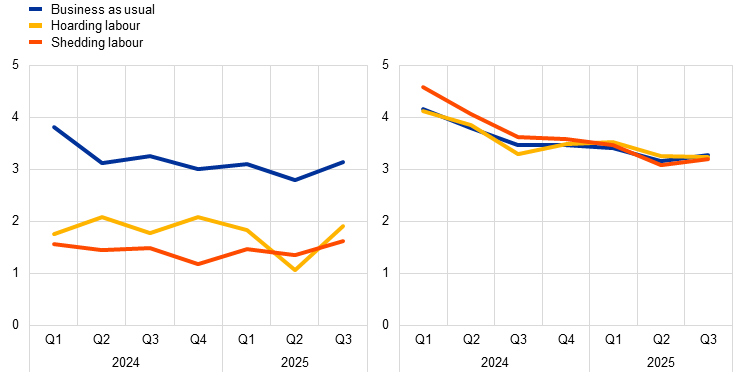
Firms reporting a deterioration in business activity tend to have lower expectations about future increases in their selling prices one year ahead (Chart D). Firms in the “business as usual” category expect their selling prices to continue to increase at a faster pace (by 3.1% year on year in the third quarter of 2025) than firms that have been negatively affected by shocks to their business activity in the past (1.9% for firms hoarding labour and 1.6% for firms not hoarding labour in the third quarter of 2025). These differences are not driven by firms’ expectations about the Harmonised Index of Consumer Prices (HICP), as all groups have similar HICP inflation expectations on average. This suggests that independently of the decision to hoard labour, firms affected by a deterioration in their business activity do not expect to be able to increase their prices by as much as their peers, hinting at weaker demand for their products or stronger competitive pressures. This weaker pricing power while facing similar wage growth could erode profit margins, forcing these firms to explore other channels to lower their labour costs.[4]
Chart D
Firms’ expectations about selling prices and inflation
(annual percentage changes)
a) Firms’ own selling prices | b) HICP inflation |
|---|---|
 | |
Sources: ECB and European Commission Survey on the Access to Finance of Enterprises (SAFE), and ECB staff calculations.
Notes: The charts show firms’ expectations for the next 12 months. The latest observations are for the third quarter of 2025.
Overall, there is evidence of a link between firms’ labour hoarding decisions and their future labour cost growth expectations. Chart E illustrates the factors driving firms’ total labour cost growth expectations across the groups. The higher labour cost growth expectations of firms in the “business as usual” category can be explained by their higher employment expectations (blue bars). By contrast, firms in the labour hoarding and labour shedding groups expect lower employment growth, but higher wage costs once deflated by their own selling prices (light green bars). This indicator of real wages is the relevant price of labour for the firms as it reflects their capacity to finance labour costs by raising their selling prices. Given that firms in the labour hoarding and labour shedding groups expect to be less able to increase their selling prices in the future, they expect their current workforce to become relatively more expensive in the coming year. Accordingly, firms’ labour cost growth expectations offer valuable insights for assessing labour hoarding decisions. They also help to better understand the cyclical recovery in labour productivity that usually follows periods characterised by strong labour hoarding.
Chart E
Decomposition of labour cost growth expectations by firm group
(annual percentage changes and percentage point contributions)

Sources: ECB and European Commission Survey on the Access to Finance of Enterprises (SAFE), and ECB staff calculations.
Notes: The chart decomposes the evolution of firms’ expected labour costs in terms of their components: employment, real wages and selling price inflation. The indicator for real wages reflects the firm’s ability to finance labour costs by increasing its selling prices. For the same wage increase, a worker becomes more expensive if the firm is less able to increase its prices in comparison with its peers. The price inflation component has been rewritten in terms of firms’ HICP expectations. Thus, the “Selling prices / HICP” component is the ratio between selling price inflation expectations and HICP inflation expectations, and provides an indication of how firms expect their selling prices to evolve in comparison with HICP inflation. The decomposition is additive, with the components summing up to the expected total labour cost. The residual caters for possible aggregation biases, as all responses are firms’ reported expectations over the next year and are retrieved from the SAFE. The latest observations are for the third quarter of 2025.
References
Arce, Ó. and Sondermann, D. (2024), “Low for long? Reasons for the recent decline in productivity”, The ECB Blog, ECB, 6 May.
Bates, C., Bodnár, K., Healy, P. and Roca I Llevadot, M. (2025), “Wage developments during and after the high inflation period”, Economic Bulletin, Issue 1, ECB.
Bates, C., Botelho, V., Holton, S., Roca I Llevadot, M. and Stanislao, M. (2024), “The ECB wage tracker: your guide to euro area wage developments”, The ECB Blog, ECB, 18 December.
Botelho, V. (2024), “Higher profit margins have helped firms hoard labour”, Economic Bulletin, Issue 4, ECB.
Ferrando, A., Lamboglia, S. and Rariga, J. (2025), “Determinants of inflation expectations of firms in the SAFE”, Economic Bulletin, Issue 4, ECB.
The ECB’s labour hoarding indicator and its connection to the recent cyclical recovery in labour productivity are discussed in Botelho (2024) and Arce and Sondermann (2024).
The exceptional period of labour hoarding that occurred during the pandemic and the contribution of unique factors such as the widespread use of job retention schemes at that time are not covered in this box.
Similarity in wage growth is also consistent with a fully decentralised competitive labour market as wages equalised in a competitive labour market. See Bates et al. (2025) for an overview of recent wage growth developments. Additionally, Bates et al. (2024) provide an analysis of collective bargaining agreements.
Ferrando et al. (2025) link HICP inflation expectations with employment growth expectations, although this channel contributes little to developments in inflation expectations over time.