



Published as part of the ECB Economic Bulletin, Issue 8/2025.
Trade policy uncertainty has risen significantly in the face of higher tariffs and tariff threats, adding a new layer of complexity to assessing the global economic outlook. Shifts in tariff and trade policy, unpredictable communication and the move away from rules-based multilateralism towards bilateral leverage have heightened uncertainty for firms and investors. This has influenced sourcing, production and investment decisions, and may weigh on trade dynamics, investment and overall macroeconomic performance. Moreover, uncertainty can affect expectations and dampen activity even in the absence of concrete policy changes. Monitoring it has therefore become crucial to assessing the economic outlook. Trade policy uncertainty has been an important part of the technical assumptions underlying recent rounds of the Eurosystem/ECB staff macroeconomic projections for the euro area.[1]
However, trade policy uncertainty is unobservable and difficult to model. To capture it, indicators such as the trade policy uncertainty (TPU) index set out in Caldara et al. (2020) count press articles in which trade-related and uncertainty-related keywords appear in close proximity. This index, shown in Chart A for 1990-2025, remained subdued during 1990-2016 before rising during the first Trump election campaign and presidency as well as the first US-China trade conflict, in 2018-20. In April 2025 it reached a historical high when the second Trump Administration imposed a 10% baseline tariff on most imports and additional country-specific tariffs of up to 50%. Although the TPU index has since eased, it remains elevated by historical standards.
As regards gauging the macroeconomic effects of trade policy uncertainty, for the last couple of quarters standard linear models often imply implausibly large effects. One reason for this is that these models extrapolate from historical relations that may no longer hold. Another reason relates to the construction of the TPU index itself: the April spike implies that a very large proportion (around 10%) of all press articles in the underlying text data corpus mention trade policy uncertainty-related keywords, which suggests the index may have been inflated by heightened media attention or trade policy keywords being mentioned in the context of other topics.
Chart A
Trade policy uncertainty index
(percentages of press articles mentioning TPU keywords, multiplied by 100)
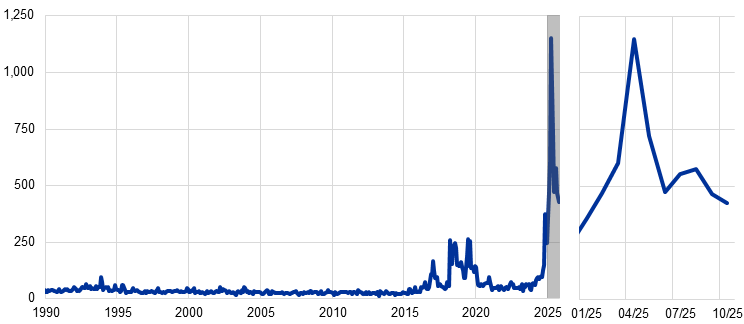
Sources: Caldara et al. (2020) and ECB staff calculations.
Note: The chart shows the raw TPU index as reported by Caldara et al. (2020).
The contamination of text-based TPU indicators is likely related to media coverage of trade policy coinciding with broader economic or political reporting. One concern is that policy actions have heightened uncertainty not only in trade but also in other policy areas. As a result, measured trade policy uncertainty may overlap with other forms of uncertainty. For instance, an article published by Reuters in June (Saphir, 2025) mentions trade policy, but primarily in the context of geopolitical risk: “with the U.S. economy already expected to slow under pressure from the Trump administration’s high import tariffs, a rise in oil prices resulting from the conflict [the strike on Iran] ‘could provide powerful downward pressure on households’ ability to spend...”. Such reporting also highlights another borderline case: articles discussing the economic uncertainty regarding the effects of tariffs rather than uncertainty about trade policy itself, as in “and while it is also expected to show inflation running near the Fed’s 2% goal last month, many Fed officials expect tariffs to feed into higher prices…” in the same article. Consequently, media reports may inflate counts of TPU-related keywords when the index is interpreted in a strictly economic sense. Against this background, this box cautions against mechanically interpreting TPU indicator readings as pure uncertainty shocks and proposes an alternative measure for use in standard macroeconomic models.
The standard TPU measure can be refined by eliminating contaminating influences. These influences become problematic when econometric analysis is seeking to disentangle distinct uncertainty channels, for instance in scenario analysis, and may lead to double-counting if readings from the raw TPU measure are treated as a primitive trade policy uncertainty shock. This box therefore proposes an alternative TPU measure, which uses the raw index cleaned for cases of keyword-driven co-mentions, such as those cited in the previous paragraph. Rather than being constructed from the ground up, the unadjusted series is cleaned indirectly by regressing it on a set of proxies, a constant and a COVID-19 pandemic dummy. This removes variation explained by historical co-movements of uncertainty-related keywords while preserving changes that extend beyond them. The first set of proxies controls for instances where broad uncertainty coverage inflates TPU counts, and includes: the categorical economic policy uncertainty indices of Baker et al. (2016), excluding trade policy; the geopolitical risk index of Caldara and Iacoviello (2022); the CBOE Volatility Index (VIX); and oil price volatility. The second set addresses episodes when financial or supply chain stress drives reporting on trade-related risks: the US National Financial Conditions Index (NFCI) and the Global Supply Chain Pressure Index (GSCPI). Finally, the effective tariff rate, defined as customs revenues relative to imports, controls for cases where media coverage reflects realised changes in trade policy rather than uncertainty about future measures.[2]
The cleaned indicator shows significantly smaller spikes throughout 2025. Chart B, panel a) presents the cleaned TPU indicator alongside the untreated indicator.[3] While it maintains the primary characteristics of the original indicator, the spikes observed in 2025 are only 20% as high and exceed the levels observed during the first US-China trade conflict by a smaller margin.[4] Recent developments are generally comparable to those observed in measures of economic policy uncertainty (EPU), such as the news-based US EPU, the three-component US EPU and the global EPU illustrated in Chart B, panel b). The coincidence of spikes across different uncertainty measures in part explains the disproportionate spike in the raw TPU indicator if not controlled for. At the same time, the cleaned TPU indicator still spikes during the first US-China trade conflict, aligning well with the raw TPU. Taken together, this supports the view that the unadjusted TPU indicator may be misinterpreted in the present high-uncertainty environment unless a narrow interpretation of trade policy uncertainty shocks is adopted.
Chart B
The TPU index and other uncertainty measures
a) TPU and cleaned TPU | b) Cleaned TPU and economic policy uncertainty measures |
|---|---|
(diffusion indices) | (diffusion indices, standardised) |
 |  |
Sources: Panel a): Caldara et al. (2022) and ECB staff calculations; Panel b): Baker et al. (2016), Davis (2016) and ECB staff calculations.
Note: Latest observations: September 2025.
The adjusted TPU index allows counterfactual scenarios to be constructed that yield more plausible estimates of macroeconomic impacts. On the basis of the adjusted index, alternative paths for the degree of trade policy uncertainty can be defined and updated as new data become available, providing a flexible input for conditional forecasting and projection exercises. Chart C, panel a) illustrates two scenarios: one in which TPU declines from current levels to the average observed during the first trade conflict, and another that assumes a more protracted decline. Chart C, panel b) shows the corresponding effects on US GDP and on global GDP (excluding the US), taking into account TPU-implied shocks since the beginning of the year. Under these assumptions, GDP in the United States and the rest of the world would contract by about 0.1 percentage points by the end of 2027 if uncertainty fell back to first trade conflict levels, but by roughly 0.2 percentage points if uncertainty remained elevated for longer.
Chart C
The impact of trade policy uncertainty on growth
a) Evolution of trade policy uncertainty
(index, three-month moving averages)

b) Cumulative impact of uncertainty on GDP growth, 2025-27
(percentage points)

Source: ECB staff calculations.
Notes: Panel a): Latest observation: July 2025, extrapolations thereafter. Panel b): The impacts are computed from forecasts based on Bayesian vector autoregression models, conditional on the assumed path of cleaned TPU. The models include, for one region at a time, the cleaned TPU; the logs of GDP, investment and CPI; as well as a COVID-19 pandemic dummy. The TPU shock is identified with Cholesky identification.
In conclusion, adjusting TPU measures can improve their indicator properties and make them easier to interpret. This box argues that text-based measures of trade policy uncertainty might capture a broader concept of uncertainty than uncertainty surrounding trade policy announcements and implementation alone. Once confounding influences and media cycle effects are removed, adjusted measures of trade policy uncertainty yield less sizeable macroeconomic impacts than commonly reported in the literature. In addition, if a more restrictive definition of trade policy uncertainty is adopted, these alternative indicators can readily be used to define scenarios for conditional forecasting and projection exercises. In this context, the adjusted TPU index was used as a starting point for analysing the impact of trade policy uncertainty in the Eurosystem/ECB staff macroeconomic projections for the euro area, and was employed both for baseline projections and scenario analysis.
References
Baker, S.R., Bloom, N. and Davis, S.J. (2016), “Measuring Economic Policy Uncertainty”, The Quarterly Journal of Economics, Vol. 131, Issue 4, November, pp. 1593-1636.
Caldara, D. and Iacoviello, M. (2022),“Measuring Geopolitical Risk”, American Economic Review, Vol. 112, No 4, April, pp. 1194-1225.
Caldara, D., Iacoviello, M., Molligo, P., Prestipino, A. and Raffo, A. (2020), “The economic effects of trade policy uncertainty”, Journal of Monetary Economics, Vol. 109, January, pp. 38-59.
Davis, S.J. (2016), “An Index of Global Economic Policy Uncertainty”, NBER Working Papers, No 22740, National Bureau of Economic Research, October.
Saphir, A. (2025), “US attack on Iran adds to economic uncertainty”, Reuters, 23 June.
See Box 2 of “Eurosystem staff macroeconomic projections for the euro area, June 2025” and Box 1 of “ECB staff macroeconomic projections for the euro area, September 2025”.
The effective tariff rate is outlier-adjusted.
The cleaned index is centred on its long-term historical average. Negative values hence indicate cleaned TPU levels below that average while positive values indicate above-average uncertainty.
The adjusted indicator is slightly more volatile, potentially adding noise to the analysis.