



Published as part of the ECB Economic Bulletin, Issue 2/2026.
Euro area business investment has been relatively muted in recent years, with its components displaying a two-speed dynamic. While overall investment performance has been modest, investment in tangible assets and investment in intangible assets have shown diverging trends since 2020 (Chart A). At the end of 2025, intangible assets – which encompass intellectual property products (IPP) including computer software and databases as well as research and development (R&D) – accounted for around 80% of the cumulative expansion in business investment recorded since the fourth quarter of 2019. This is despite representing only around two-thirds of the capital expenditure on tangible assets, which include machinery and equipment. This widening gap has likely been driven by the strong rise in investment in digital assets. Against this background, this box examines the evolution of digital investment in the euro area by using proxies that track the main digital-related asset categories. It also discusses the economic implications of the growing share of digital investment in overall euro area business investment.
Chart A
Euro area non-construction investment by asset category
(cumulative percentage changes since the fourth quarter of 2019, percentage point contributions)

Sources: Eurostat and ECB staff calculations.
Notes: Non-construction investment excludes Irish IPP. Components do not sum to the total owing to the exclusion of the biological resources component. The latest observations are for the fourth quarter of 2025.
There has been a notable rise in digital investment in the euro area over the past decade. Measuring investment across the digital ecosystem is challenging, particularly in Europe. Digital-related investment cannot easily be distinguished from other forms of investment because the euro area national accounts do not currently report the relevant breakdowns for investment in digital technologies in sufficient detail (particularly at quarterly frequency).[1] Therefore, we have built a proxy for digital investment based on annual euro area accounts available until 2024, which provide more detailed asset and sector breakdowns than the quarterly accounts. The proxy consists of three elements. First, we approximate physical digital infrastructure (e.g. data centre buildings) using non-residential construction in the information and communication sector. Second, tangible digital investment is measured as investment in information and communications technology (ICT) equipment in the business economy.[2] Third, intangible digital investment covers all IPP investment (including computer software and databases and R&D) in the information and communication sector as well as investment in computer software and databases in the rest of the business economy.[3] The overall increase in digital investment between 2014 and 2024 was more than three times the cumulative growth in GDP over that period. Intangible investment made up the lion’s share of digital investment and has supported the rise in the proxy over the past decade. Tangible business expenditure on ICT equipment also accounted for a significant share, while our proxy suggests that the share of investment in data centre construction remained comparatively small (Chart B).
Chart B
Digital investment proxy for the euro area with asset breakdown

Sources: Eurostat, ECB, and ECB staff calculations.
Notes: Digital investment proxy refers to: i) investment in non-residential construction of buildings and structures in the information and communication sector; ii) investment in ICT equipment in the business economy; iii) IPP investment (in computer software and databases and R&D) in the information and communication sector; and (iv) investment in computer software and databases in the rest of the business economy (excluding the information and communication sector). Missing country values have been estimated on the basis of known euro area aggregates of country-sector shares. The latest observations are for 2024.
Production data suggest that euro area digital investment accelerated in 2025. Disaggregated investment data by sector and asset are currently only available up to 2024. However, a more timely proxy for digital services output can be constructed as a weighted aggregation of the monthly production of publishing activities (of which software publishing is a major component), computer programming, consultancy and related activities, and information service activities. This proxy correlates well with – and also outpaces – growth in IPP investment and indicates that digital investment accelerated in 2025 (Chart C). Digital services production has also grown somewhat faster than the digital investment proxy over recent years. But digital services production is only a rough proxy for digital investment. Around 80% of euro area computer programming production and information service activities production – the largest component of our digital services proxy – was used domestically. However, most of this production was not capitalised as investment but rather treated as intermediate consumption. There are pronounced differences across countries in this respect, owing in part to the absence of harmonised measurement and accounting practices among national statistical offices in the EU (Chart D).[4]
Chart C
Euro area digital services output proxy and intellectual property products
(year-on-year percentage changes)

Sources: Eurostat and ECB staff calculations.
Notes: The proxy for digital services output covers the weighted non-seasonally adjusted production of publishing activities (statistical classification of economic activities (NACE) sector J58), computer programming, consultancy and related activities (NACE sector J62) and information service activities (NACE sector J63). IPP exclude Ireland. The latest observations are for the fourth quarter of 2025 for IPP and December 2025 for production data.
Chart D
Uses of computer programming and information service activities in the euro area
(percentage share of total use)

Sources: European Commission (Figaro input-output tables) and ECB staff calculations.
Notes: Use of production in combined NACE sectors J62 and J63. The latest observations are for 2023.
While digital investment in the euro area has expanded strongly, the pace of growth has been notably slower than in the United States. When extending the digital proxy with the estimated strong growth in digital services output in 2025 and netting out distortions in the overall trend owing to IPP volatility in Ireland, the results suggest that euro area digital investment may have expanded by just over 60% between 2014 and 2025 (Chart E). Despite this strong growth, a similar proxy for the United States more than doubled over the same period, accelerating notably in 2025 on the back of a strong pick-up in data centre investment.[5] This striking and ostensibly widening gap with the United States warrants further research to assess the extent to which it primarily reflects the generally smaller size of European firms, which makes the adoption of new technologies less profitable, structural rigidities in the euro area, or simply the United States’ “first mover” advantage in this field.[6]
Chart E
Digital investment proxy for the euro area and the United States
(index: 2014 = 100)
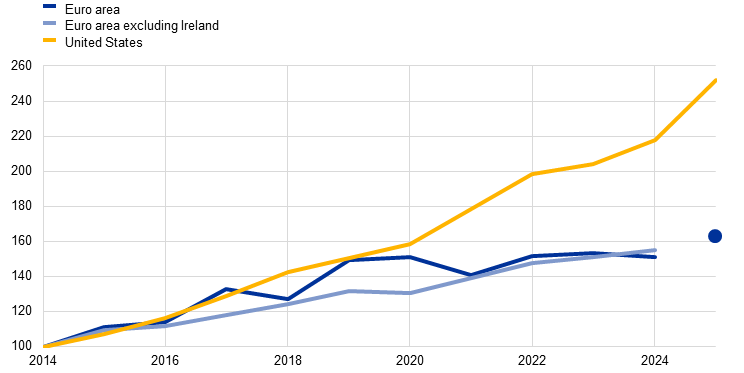
Sources: Eurostat, US Bureau of Economic Analysis, ECB, and ECB staff calculations.
Notes: The digital proxy for the euro area is as in Chart B. The blue dot extends to 2025 on the basis of the annual growth of the digital services output proxy shown in Chart C. The proxy for the United States combines investment in data centres, information processing equipment and computer software. The latest observations are for the fourth quarter of 2025 for US data, December 2025 for digital services production data and 2024 for other data.
Looking ahead, the digital share of investment is expected to continue to grow, with significant implications for the business cycle and policy. Digital investment is expected to increase markedly in the future, spurred by venture capital investments and Next Generation EU funding. In addition, two EU-wide schemes – the AI Continent Action Plan and the Apply AI Strategy – have recently been introduced with the aim of injecting large sums into digital investment and harnessing additional national funds from EU Member States.[7] However, according to a survey by the European Data Centre Association, a further acceleration of digital investment could be hampered in the event of insufficient energy supply, a shortage of skilled staff or overregulation.[8] Euro area digital investment could also slow if artificial intelligence does not deliver on the expected productivity gains and cost reductions, leading to downward revisions to future demand.
References
Andersson, M., Jarvis, V. and Soudan, M. (2025), “Business investment: why is the euro area lagging behind the United States?”, Economic Bulletin, Issue 2, ECB.
European Commission (2025a), “AI Continent Action Plan”.
European Commission (2025b), “Apply AI Strategy”.
European Data Centre Association (2025), “State of European Data Centres 2025”.
European Investment Bank (2026), “AI adoption, productivity and employment: Evidence from European firms”, Working Paper 2026/02, January.
Ferrando, A., Lamboglia, S., Rariga, J. and Schmidt, M. (2026), “Adopting and investing in AI: evidence from euro area firms in the SAFE”, Economic Bulletin, Issue 2, ECB.
Gal, P., Hooley, J., Ozturk, F. and Unsal, F. (2025), “Business investment in the face of the digital transformation: Initial evidence”, OECD Economics Department Working Papers, No 1859, OECD.
Lane, P. (2026), “Interview with La Stampa”, ECB, 16 January.
Nonnis, A., Roth, F. and Bounfour, A. (2025), “Intangible capital in France and Germany: Measurement issues and their impact on productivity”, VoxEU Column, Centre for Economic Policy Research, 6 October.
Rubinton, H. and Ankit Patro, B. (2026), “Tracking AI’s Contribution to GDP Growth”, On the Economy Blog, Federal Reserve Bank of St. Louis, 12 January.
The new global System of National Accounts 2025, expected to be implemented in 2029-30, should provide additional insights into AI, data, cloud computing and digital intermediaries.
The business economy comprises the whole economy excluding agriculture, forestry and fishing, public services, arts and entertainment and other services categories (i.e. it excludes statistical classification of economic activities (NACE) sections A, O to Q and R to U respectively).
Our approach follows similar compilations for the United States by Federal Reserve researchers (see Rubinton and Ankit Patro, 2026) and the recent comparison by the OECD in Gal et al. (2025).
See Nonnis et al. (2025).
For a broader comparison of euro area and US investment, see Andersson et al. (2025).
In this issue of the Economic Bulletin, Ferrando et al. (2026) report on a recent SAFE survey on artificial intelligence (AI) usage and investment trends and note a strong correlation between AI adoption and investment expenditure in euro area firms. Similar results are also evident in a wider study by the European Investment Bank (2026).
See European Commission (2025a) and European Commission (2025b).
See European Data Centre Association (2025).