



Short-term forecasting of euro area economic activity in an uncertain world
Published as part of the ECB Economic Bulletin, Issue 8/2025.
1 Introduction
Assessing the short-term growth outlook and the associated risks based on incoming data is key to making monetary policy decisions. Central banks therefore develop and continuously refine their short-term GDP forecasting models that are specifically designed to give timely, reliable and data-driven insight into the current state of the economy and the near-term growth outlook. For example, since 2015 the ECB has employed a set of “workhorse” models to forecast near-term real GDP growth in the euro area (see Bańbura and Saiz, 2020).
A series of major shocks in recent years has significantly disrupted the performance of traditional forecasting methods, making it harder to produce accurate forecasts. Events such as the COVID-19 pandemic and Russia’s unjustified war against Ukraine have triggered sizeable fluctuations in economic variables and heightened the levels of uncertainty surrounding such forecasts. These events have compounded the well-known challenges inherent in real-time economic forecasting, including combining information from data collected at different frequencies (e.g. monthly versus quarterly) and accounting for differences in data release calendars, publication delays and data revisions.
Against this background, this article examines the recent enhancements made to the short-term forecasting models employed at the ECB. Our 2025 monetary policy strategy assessment underlined the importance of continuously refining forecasting tools and maintaining a broad and versatile analytical toolbox in an uncertain and rapidly changing world. To address this need, a two-fold strategy was devised to update and finetune the short-term forecasting framework. First, the existing ECB workhorse models were finely tested and improved. The purpose of these revisions was to increase the accuracy and reliability of both point and density forecasts of real GDP growth in the euro area. Density forecasts are particularly important for quantifying forecast uncertainty and can be used to evaluate short-term risks surrounding Eurosystem/ECB staff macroeconomic projections. Second, alternative approaches using advanced machine learning methods were explored to complement the traditional workhorse models. While still in an experimental phase, these innovative tools can help to address instabilities and capture possible non-linearities in economic relations.
The remainder of this article is structured as follows. Section 2 assesses the key challenges for forecasting euro area economic activity since the onset of the pandemic. Section 3 introduces the revised short-term forecasting toolbox, including the workhorse models, and provides a real-time evaluation of their forecast performance. Section 4 explores a complementary machine learning approach. Section 5 concludes.
2 Forecasting challenges since the pandemic
The extreme economic developments during the pandemic were almost impossible to forecast in real time. As standard models were challenged, the ECB used several innovative approaches to forecast euro area real GDP growth, taking into account the unique characteristics and implications of the pandemic (see, for example, Battistini et al., 2020).
Since the pandemic, further major shocks have put additional strain on forecasting models, which have struggled to adapt to an environment where historical patterns may no longer serve as reliable benchmarks for the future. Similar to the pandemic, shocks such as Russia’s war against Ukraine, with the associated energy crisis and inflation surge, and the more recent geopolitical and trade tensions have strongly affected the euro area economy. These disruptions have also caused considerable fluctuations in key economic indicators, posing major challenges when updating and re-estimating short-term forecasting models, making it more difficult to discern economic relations. The sudden and extreme fluctuations in economic activity disrupted seasonal patterns, creating problems for traditional seasonal adjustment methods and leading to potential distortions in the adjusted data. In addition, revisions to GDP and other economic data have been more frequent and substantial than in the past, adding another layer of complexity.[1]
These shocks have had highly heterogeneous effects across sectors, which are not easily captured by short-term forecasting models. During the pandemic, contact-intensive services, such as hospitality, travel and entertainment, were hit particularly hard owing to restrictions on movement and social interaction, while other services, such as digital services and e-commerce, experienced elevated demand. The subsequent energy crisis further exacerbated sectoral disparities, as energy-intensive industries, such as manufacturing and transport, faced sharp increases in production costs. These sector-specific shifts in economic activity posed significant challenges for short-term GDP forecasting models, increasing the divergence between survey-based data and hard economic indicators. Thus, it has become evident that forecasting models require greater flexibility and adaptability to account for rapid changes in sectoral composition and their impact on aggregate output.
Structural factors and underlying trends, such as climate change, demographic changes (e.g. an ageing population) and the growth of digital technologies, also play a role. While these factors are expected to have a significant impact on the economy in the medium to long term, they may also influence short-term economic developments. However, their gradual and multifaceted nature makes it challenging to incorporate them into short-term forecasting models.
These issues have collectively challenged the performance of the existing short-term forecasting models used at the ECB. While the revised short-term forecasting toolbox described in this article does not resolve all these issues, it addresses some of the key challenges, such as changes in the relation between survey data and hard indicators, heightened volatility, forecast uncertainty (including parameter uncertainty) and the incorporation of additional data sources to more comprehensively capture different aspects of the economy. However, issues such as seasonal adjustment, intellectual property product investments in Ireland and structural changes do not fall within the scope of the revised toolbox.
3 The revised short-term forecasting toolbox
Central banks use a variety of econometric models for business cycle analysis and short-term forecasting of economic activity. Among the most widely used are simple linear regression models (bridge equations), dynamic factor models (DFMs), vector autoregressive models (VARs) and mixed data sampling (MIDAS) models. Each of these model classes has distinct characteristics that make them well suited for short-term forecasting, and all have been widely applied by academics, central banks and other forecasters.[2]
The previous generation of short-term forecast models for euro area real GDP growth was based on a system of linear regressions or bridge equations.[3] This framework (hereinafter the “old ECB models”) relied on a system of linear regressions (bridge equations) to forecast quarterly GDP growth using a set of quarterly predictors and monthly predictors aggregated to quarterly frequency. The old ECB models adopted a supply perspective for real GDP measurement, given its more complete and timelier data coverage and greater accuracy relative to the demand perspective.[4] The monthly predictors included in the bridge equations for GDP growth forecasts were, in turn, forecast using auxiliary models (DFMs and VARs) incorporating information from other monthly variables. The dataset used was of medium size (30 indicators) and combined hard indicators (e.g. industrial production, retail sales) with soft data (surveys) and financial indicators. Finally, in addition to producing point forecasts, this framework provided density forecasts to capture the uncertainty around the point forecasts as well as a decomposition of the drivers of forecast revisions between updates (a “news analysis”).
The old ECB models provided reasonably accurate euro area real GDP growth forecasts until late 2019. However, their performance deteriorated following the outbreak of the pandemic. While their performance has recovered somewhat, ECB staff refined this framework, placing particular emphasis on improving its forecast performance in the post-pandemic period and developing approaches that are more robust to the impact of large shocks. The following subsection describes the features of this new framework. To facilitate comparison, Table 1 outlines the characteristics of the old and new frameworks.
Table 1
Characteristics of old and new ECB models
Old ECB models | New ECB models | |
|---|---|---|
Bridge equations | Six bridge equations of two types (supply side, survey-based)
| Two bridge equations of one type (supply side)
|
Auxiliary models | Three VARs, two DFMs | Three VARs, three DFMs |
Point forecasts | Mean | Median1) |
Density forecasts | Combination of six normal densities | Combination of two densities |
1) Owing to the increased volatility of the data, point forecasts in new ECB models are calculated using the median of the distribution of possible outcomes. The median provides more stable forecasts than the mean, as it is less influenced by extreme values.
3.1 Revised bridge equation framework
The revised framework is still based on bridge equations, which are relatively flexible despite their simplicity. The new ECB models continue to deploy a system of linear regression models, focusing on forecasting GDP growth from the supply side (i.e. value added by sector). This approach was preferred because it is straightforward to estimate, easy to interpret and communicate, and provides better forecast accuracy compared with other models. At the same time, despite its simple structure, the bridge equation framework is flexible since it can accommodate a range of auxiliary model classes.
The new ECB models incorporate two types of state-of-the-art auxiliary models. Like its predecessor, the new model relies on the same two auxiliary model types: DFMs and VARs.[5] However, these auxiliary models were comprehensively revised, combining monthly and quarterly indicators and including time-varying volatility to better capture changes in the dynamics of economic data (see Box 1 for technical details of the revised framework).
The set of predictors was revised to include newly available data, such as services production, and to achieve a more balanced proportion of survey-based and hard indicators. This adjustment addresses the limitations of relying on survey-based or qualitative indicators, which, despite being timely and informative, have shown a weaker and less stable relation with economic activity in recent years. Furthermore, the lack of hard indicators for the services sector was identified as a factor in the deterioration in the performance of the old ECB models.
Like their predecessors, the new ECB models can produce both point and density forecasts. Point forecasts give a single, central estimate of where GDP is expected to go and are the primary forecasts reported. However, since the pandemic, heightened uncertainty has made it increasingly important to look beyond single-point predictions and to focus on density forecasts. Density forecasts offer a range of possible GDP outcomes and their associated probabilities. In simple terms, the width of the density forecast indicates the uncertainty surrounding the point forecast.
The new framework continues to report the impact of incoming data on forecast revisions. In addition to point and density forecasts, the new framework also provides a decomposition of GDP growth forecast revisions (i.e. the difference between consecutive GDP forecasts) into the model-based surprises or “news” content in the releases of monthly and quarterly predictors (plus the effects of historical data revisions and parameter re-estimation).[6] Accordingly, the sign of the news (positive or negative) indicates whether the new data release was better or worse than expected by the model. For the sake of clarity, the news decomposition is grouped into broad categories of economic indicators, such as services indicators, industry indicators and surveys (see Box 2 for an illustration of the use of the revised framework in practice for real-time, short-term forecast analysis).
Box 1
The revised system of bridge equations: technical summary
The revised toolbox continues to rely on a bridge equation system – a short-term forecasting model widely used among central banks and other forecasters.[7] It is a simple linear regression, in which the quarterly indicator of interest (e.g. quarterly real GDP growth) is predicted using other quarterly regressors, such as its supply-side GDP components (e.g. value added in industry, services and construction). Accordingly, the bridge equation for quarterly GDP growth can be specified as follows:
where is the target indicator and is the predictor indicator () at the same frequency. The intercept is denoted by , while is the regression coefficients and captures the regression residual. The bridge equation system consists of two linear regressions. Both include the same set of quarterly predictors: value added in industry, value added in services and value added in construction (), which are predicted by two different auxiliary models (). These equations are estimated using Bayesian techniques and assuming normal-inverse-gamma priors. The estimation sample starts in 1995.
Each of the quarterly predictors used to forecast GDP growth is forecast by means of a dynamic factor model (DFM) and a vector autoregressive model (VAR). Both models include quarterly and monthly indicators (i.e. mixed frequencies), are estimated using Bayesian techniques, and feature time-varying stochastic volatilities leading to better predictions of economic activity in times of high uncertainty. Both models can also handle different data frequencies and missing observations effectively. In addition, certain model properties, such as the common factor structure in DFMs and the outlier correction for time-varying volatilities in VARs, help to filter out noise in the data.
The mixed-frequency DFM mainly follows the approach proposed by Antolín-Díaz et al. (2017, 2024) and combines it with the suggestion of Camacho and Pérez-Quirós (2010) in dealing with survey-based indicators in the model.[8] For each quarterly GDP predictor, a separate auxiliary DFM is estimated using a small set of monthly indicators. Each DFM includes one common factor and a number of idiosyncratic components which follow a second-order autoregressive process. The model is specified and estimated in state-space form using Bayesian techniques, with the residuals in both the measurement and transition equations exhibiting stochastic volatility and outlier adjustment in line with Carriero et al. (2024).
The mixed-frequency VAR model extends the Bayesian VARs with stochastic volatility and outlier adjustments to a mixed-frequency setting. Specifically, the mixed-frequency auxiliary VAR models allow for -distributed errors and outlier adjustment in the stochastic volatility, making it more robust to large shocks and outliers. The VAR estimation is based on Bayesian techniques, using the algorithm developed by Chan et al. (2023) for sampling missing observations (e.g. due to mixed frequencies or publication lags). In line with the approach used for the auxiliary DFMs, separate auxiliary VARs are estimated for each quarterly predictor using the same datasets as the DFMs. Each VAR is specified with three lags and with Minnesota priors for the coefficients.
Finally, the quarterly GDP growth forecasts are generated in two steps. First, the forecasts for quarterly predictors – value added in industry, in services, in construction – are produced using the auxiliary models. Second, the predictions for these indicators are used in the two bridge equations to generate forecasts of GDP growth. Based on Bayesian estimation techniques, all the probability distributions are estimated for the two steps. The individual probability distributions for GDP growth are pooled to calculate both point and density forecasts for GDP growth. Point forecasts for GDP growth are obtained as the median of the combined density forecasts from the two bridge equations. The predictive densities take into account time-varying volatilities and therefore consider both changing parameters and residual uncertainties surrounding the central tendency of GDP growth forecasts.
3.2 Forecast performance
A real-time forecast evaluation exercise was conducted for the new ECB models, with a particular focus on post-pandemic performance. The forecast accuracy of the models was compared both with the old ECB models and with Eurosystem/ECB staff macroeconomic projections. For this purpose, real-time vintages of the dataset were constructed using information from the ECB Data Portal.[9]
The evaluation of its performance follows the publication calendars for statistical data (such as industrial production) and survey-based sentiment indicators (such as the Purchasing Managers Index). This leads to a biweekly forecast calendar, producing a total of 12 estimates for each target quarter in the evaluation sample, meaning that at each point in time, forecasts are generated for the next two quarters to be released. The first forecast is generated approximately five months before the end of the target quarter and the final forecast is produced two weeks after the quarter ends. For the point forecasts, the accuracy is assessed using the bias to measure systematic overprediction or underprediction and the mean absolute forecast error (MAFE) to evaluate the average size of forecast errors regardless of the sign.[10] The evaluation period spans the post-pandemic period, from the first quarter of 2022 to the second quarter of 2025. Both metrics are calculated using the first release (preliminary flash estimate) of GDP growth published around 30 days after the end of the reference quarter.
The forecast accuracy of the new ECB models in the post-pandemic period is noticeably higher than that of their predecessors.[11] Chart 1 shows the bias (panel a) and MAFE (panel b) for the old ECB models (yellow bars) and the new ECB models (blue bars) as well as for the Eurosystem/ECB staff macroeconomic projections (red line) for the entire evaluation period. While forecasts based on the old ECB models tended to underpredict real GDP growth, as indicated by their negative bias, the new ECB models generally exhibit a bias much closer to zero. The new ECB models are also more accurate overall, as demonstrated by their lower MAFE values compared with the old ECB models. However, while forecast accuracy typically improves (i.e. MAFE decreases) as more information becomes available, the accuracy of the forecasts in this case was more erratic. This could be attributed to the relatively short evaluation sample, which coincided with a period of heightened uncertainty due to successive shocks to euro area economic activity. These include Russia’s war against Ukraine, with the subsequent surge in energy prices and inflation, and, more recently, trade-related uncertainties. When comparing the forecast performance of the new ECB models with the Eurosystem/ECB staff macroeconomic projections (which incorporate expert judgement), no systematic direction of bias was observed in either. However, the macroeconomic projections proved to be more accurate overall.
Chart 1
Forecast accuracy of ECB models and Eurosystem/ECB staff macroeconomic projections since 2022
a) Bias
(percentage points)

b) Mean absolute forecast error
(percentage points)

Source: ECB calculations.
Notes: For each quarter, a sequence of 12 real-time forecast updates is evaluated. The forecast horizon (x-axis) is defined as the distance (in months) between the date of the forecast and the end of the reference quarter. A convention is adopted in line with the fact that Eurosystem/ECB staff macroeconomic projections are finalised around the middle of the second month of each quarter (1.5 or 4.5 months before the end of the reference quarter). Bias is defined as the average difference between the forecast and the outcome. A positive (negative) bias indicates overprediction (underprediction). The forecast accuracy is measured by the mean absolute forecast error. GDP forecasts are evaluated against the preliminary flash estimate of GDP growth (released at the end of the first month of the following quarter).
The new ECB models also deliver more accurate density forecasts. In addition to evaluating the point forecasts, the accuracy of the entire forecast distribution is assessed. To this end, the continuous ranked probability score (CRPS), which compares predicted distributions to actual outcomes, is used to evaluate the density forecasts produced by the old and new ECB models. The Eurosystem/ECB staff macroeconomic projections are not included in this evaluation, as they do not provide density forecasts.[12] Chart 2 shows that the new ECB models deliver more accurate probabilities (lower CRPS) than the old ECB models at all forecast horizons. This result is unsurprising, as the inclusion of time-varying volatilities enhances the calibration of the forecast densities.
Chart 2
Density forecast accuracy – continuous ranked probability score
(percentage points)

Source: ECB calculations.
Notes: See the notes to Chart 1. The continuous ranked probability score measures the accuracy of density forecasts using the expected absolute difference between the forecast distribution and the realised value. Lower values indicate more accurate and better calibrated forecasts.
4 Complementary framework: a quantile regression forest model
Machine learning models are used increasingly for economic forecasting thanks to their flexibility and strong predictive performance. Unlike traditional time series forecasting models, which rely on specific econometric frameworks and parametric assumptions, machine learning models identify patterns directly from the data. This enables them to capture complex, possibly non-linear relations among variables. Although machine learning models typically treat observations as independent and do not explicitly account for temporal dependencies, this feature can be advantageous in rapidly changing environments where recent lags may be less informative or where underlying dynamics take time to unfold.
This section briefly describes one specific machine learning model – the quantile regression forest (QRF) model – that has been tested for short-term GDP forecasting. QRF models are a well-established machine learning method that is already deployed at the ECB to predict short-term inflation dynamics with comparatively high accuracy.[13] The QRF model combines the concept of a quantile regression, which estimates specific percentiles of the distribution of the target variable, with the predictive power of an ensemble of decision trees (i.e. forests).[14] By aggregating predictions from many trees, the QRF model provides both a point forecast and a predictive distribution of the target variable, which is particularly useful for assessing uncertainty and risk. An additional advantage of this approach is the possibility of assessing the contribution of each predictor to the forecast using Shapley values.[15] This feature enables the impact of new data releases on the forecast revisions to be evaluated (similar to the news analysis in the bridge equation framework), thereby enhancing transparency and interpretability and reducing the perception of the model as a “black box”.
The model is estimated using contemporaneous relations between GDP growth and a broad set of economic indicators. The dataset includes industrial production, trade, surveys, financial activity and other hard data, all originally available at a monthly frequency. These are aggregated to quarterly frequency using simple averages to match the GDP data, while missing values are projected through an autoregressive integrated moving average (ARIMA) model. Forecasts are then produced using indicators at quarterly frequency for the target quarter. The forest is estimated using hyperparameters recommended in the literature on regressions, ensuring model stability and a balance between bias and variance.[16]
A real-time forecast evaluation exercise was performed for the post-pandemic period to assess the performance of the QRF model. The evaluation period spanned from the first quarter of 2022 to the second quarter of 2025 (as in Section 3.2). Six forecasts were produced for each quarter, starting five months before the end of the target quarter.[17] Chart 3 reports the forecast accuracy, showing the bias (panel a) and the MAFE (panel b) for both the QRF and the new ECB models. The QRF model displays a somewhat smaller bias in magnitude but with the same sign across all the forecast horizons. In MAFE terms, the QRF exhibits larger errors than the new ECB models at the beginning of the forecast horizon, but its accuracy improves steadily as more data become available and surpasses that of the new ECB models towards the end of the target quarter. This improvement was most pronounced in 2022, when the QRF showed higher predictive accuracy, possibly due to non-linearities as a result of the lingering effects of the pandemic and the emerging energy crisis (e.g. reopening of the economy, supply-chain disruptions). However, over a longer evaluation sample starting in 2017 (not shown), the model’s performance was slightly worse than that of the new ECB models. Overall, the QRF model performs well as a tool for short-term GDP forecasting, particularly during periods of economic instability, and can serve as a useful cross-check against the main workhorse models.
Chart 3
Forecast accuracy of the quantile regression forest model
a) Bias | b) Mean absolute forecast error |
|---|---|
(percentage points) | (percentage points) |
 |  |
Source: ECB calculations.
Notes: The forecast horizon (x-axis) is defined as the distance (in months) between the date of the forecast and the end of the reference quarter. Bias is defined as the average difference between the forecast and the outcome. A positive (negative) bias indicates overprediction (underprediction). The forecast accuracy is measured by the mean absolute forecast error. GDP forecasts are evaluated against the preliminary flash estimate of GDP growth (released at the end of the first month of the following quarter).
Box 2
A case study: short-term GDP forecasts for the third quarter of 2025 in real time
This box presents an illustrative case to show how short-term GDP forecasting models are used in the day-to-day work of the ECB. Focusing on the third quarter of 2025, this box shows the developments in the point and density forecasts produced by the new ECB models and assesses the impact of incoming data on forecast revisions.
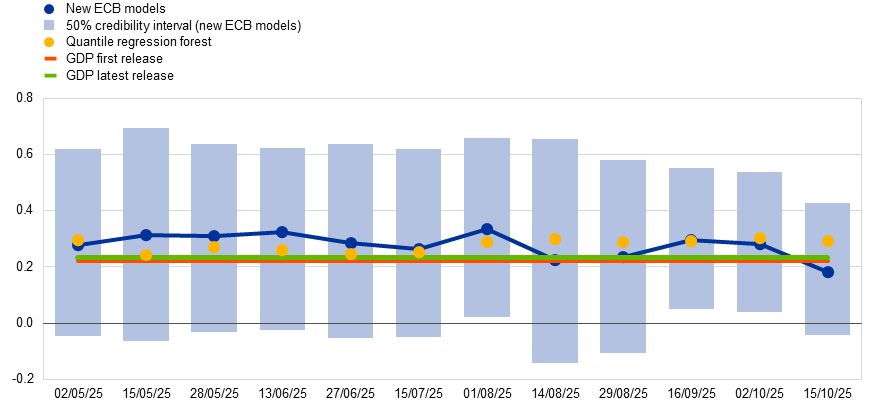
Chart A displays the sequence of 12 real-time forecasts of euro area real GDP growth for the third quarter of 2025 based on the new ECB models. Besides the point forecasts, the chart shows the range of possible outcomes within a 50% credibility interval. The first forecast was made at the beginning of May 2025, five months ahead of the release of the preliminary flash estimate of GDP. The forecasts were subsequently updated biweekly, with the final forecast generated two weeks before the GDP release on 30 October. Over the forecast horizon, the median GDP growth prediction fluctuated between 0.2% and 0.3%, declining just below 0.2% in the final mid-October iteration. This final forecast was close to the preliminary flash GDP estimate, which fell within the 50% credibility interval of the combined density forecast from the new ECB models. Forecasts produced by the complementary QRF model closely mirrored the forecasts generated by the new ECB models, with the final forecast resulting slightly above the realised value.
Chart A
Real GDP growth forecasts for the third quarter of 2025
(quarter-on-quarter percentage changes)
Sources: Eurostat and ECB calculations.
Notes: The blue line represents the point forecasts for real GDP growth in the third quarter of 2025 based on the new ECB models from different forecast updates (x-axis). The bars indicate the range of possible outcomes with a 50% probability (50% credibility interval or interquartile range) based on the new ECB models. The point forecasts of the complementary quantile regression forest model are shown as yellow dots. The red and green lines refer, respectively, to the preliminary flash estimate (30 October) and the flash estimate (14 November) of GDP growth published by Eurostat.
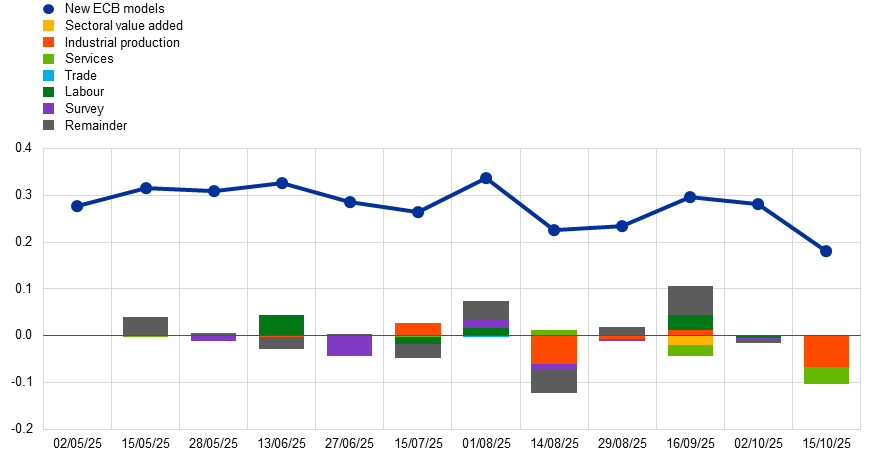
Chart B illustrates the analysis of the drivers of forecast revisions between consecutive updates for the third quarter of 2025. The bars represent model-based surprises that drive GDP forecast revisions, grouped into various indicator categories. For example, negative surprises in survey data (purple bars) contributed to downward revisions of GDP forecasts between May and July 2025. During the same period, positive surprises in the labour market indicators and in industrial production data (dark green bars and red bars respectively) pushed GDP forecasts upwards. The most significant forecast adjustments occurred later in the forecast horizon, specifically in both mid-August and mid-October. Both revisions were largely driven by negative surprises in industrial production data, with the downward revision in the final update also reflecting negative surprises in services data (light green bars). Chart B also highlights the impact of historical data revisions on forecast revisions, which are captured by the remainder category (dark grey bars). For instance, the upward revision of the forecast of 16 September 2025 was primarily driven by the remainder, largely reflecting the significant effect of industrial production data revisions on the GDP growth forecasts.
Chart B
Model-based news and revisions to real GDP growth forecasts for the third quarter of 2025
(quarterly percentage changes and percentage point contributions)
Source: ECB calculations.
Notes: The blue line represents the median point forecasts of the new ECB models (from the combined density of two bridge equations) for real GDP growth in the third quarter of 2025 from different forecast updates (x-axis). The bars indicate the decomposition of forecast revisions between consecutive updates into news stemming from different groups of indicators: Sectoral value added = sectoral value added GDP components; Industrial production = industrial production indicators; Services = services and retail indicators; Trade = international trade-related indicators; Labour = labour market indicators; Survey = survey-based indicators; Remainder = effects of historical data revisions and parameter re-estimations.
5 Conclusions
Over the past five years, a series of major shocks have posed significant challenges to economic modelling and short-term GDP forecasting. The pandemic and its associated supply-chain disruptions, the Russian invasion of Ukraine and the subsequent energy crisis and surge in inflation, and the more recent trade-related uncertainties have all contributed to sizeable fluctuations in economic activity and a more dynamic and unpredictable economic and political environment. As a result, model and forecast uncertainty have increased.
In response to the evolving economic environment, the ECB’s toolbox for short-term GDP forecasting has been comprehensively updated. This revision has focused on improving forecast performance by addressing heightened volatility and model uncertainty. A two-fold strategy was devised to update and finetune the short-term GDP forecasting framework. First, the workhorse models based on the bridge equation framework were comprehensively revised and improved. The revision incorporated state-of-the-art auxiliary DFMs and VARs with time-varying volatility. In addition, newly available indicators, such as those for the services sector, were incorporated into the dataset, building on the recommendations of Bańbura and Saiz (2020). Second, alternative approaches using advanced machine learning methods were explored to complement the traditional workhorse models. Notably, the QRF model exhibited a forecast accuracy comparable to that of the workhorse models in the post-pandemic period for both current quarter and one-quarter ahead GDP growth forecasts. This is particularly noteworthy given the purely data-driven nature of this machine learning model in contrast to the careful variable selection and parameterisation required for the workhorse models. However, it remains unclear whether the relatively strong performance of the QRF model is specific to the current highly volatile environment.
Nevertheless, it is important to recognise that the post-pandemic period continues to be marked by unusually high uncertainty, necessitating frequent and systematic evaluations and reviews of the forecasting models to ensure their accuracy. As emphasised in the ECB’s 2025 monetary policy strategy assessment, forecast performance will be monitored regularly and the short-term GDP forecasting models will be revised as needed. Furthermore, continued exploration of new data sources and advanced machine learning methods should remain a priority to further enhance short-term macroeconomic forecasting.
References
Almuzara, M., Baker, K., O’Keeffe, H. and Sbordone, A. (2023), “The New York Fed Staff Nowcast 2.0”, New York Fed Staff Nowcast Technical Paper, Federal Reserve Bank of New York, June.
Andersson, M., Blatnik, N., Byrne, S., Emter, L., González Pardo, B., Jarvis, V., Schmitz, M., Zorell, N. and Zwick, C. (2024), “Intangible assets of multinational enterprises in Ireland and their impact on euro area activity”, Occasional Paper Series, No 350, ECB, June.
Antolín-Díaz, J., Drechsel, T. and Petrella, I. (2017), “Tracking the slowdown in long-run GDP growth, The Review of Economics and Statistics, Vol. 99, No 2, May, pp. 343-356.
Antolín-Díaz, J., Drechsel, T. and Petrella, I. (2024), “Advances in nowcasting economic activity: The role of heterogeneous dynamics and fat tails”, Journal of Econometrics, Vol. 238, No 2, January.
Bańbura, M. and Modugno, M. (2014), “Maximum likelihood estimation of factor models on datasets with arbitrary pattern of missing data”, Journal of Applied Econometrics, Vol. 29, No 1, pp. 133-160.
Bańbura, M. and Saiz, L. (2020), “Short-term forecasting of euro area economic activity at the ECB”, Economic Bulletin, Issue 2, ECB.
Battistini, N., de Bondt, G., de Santis, R.A. and Saiz, L. (2020), “Assessing short-term economic developments in times of COVID-19”, Economic Bulletin, Issue 8, ECB.
Camacho, M. and Pérez-Quirós, G. (2010), “Introducing the euro-sting: Short-term indicator of euro area growth”, Journal of Applied Econometrics, Vol. 25, No 4, June/July, pp. 663-694.
Carriero, A., Clark, T.E., Marcellino, M. and Mertens, E. (2024), “Addressing COVID-19 Outliers in BVARs with Stochastic Volatility”, The Review of Economics and Statistics, Vol. 106, No 5, September, pp. 1403-1417.
Chan, J.C., Poon, A. and Zhu, D. (2023), “High-dimensional conditionally Gaussian state space models with missing data”, Journal of Econometrics, Vol. 236, No 1, September.
Deutsche Bundesbank (2023), “Models for short-term economic forecasting during the recent crises”, Monthly Report, Vol. 75, No 9, September, pp. 61-78.
Meinshausen, N. (2006), “Quantile Regression Forests”, Journal of Machine Learning Research, Vol. 7, pp. 983-999.
Lenza, M., Moutachaker, I. and Paredes, J. (2025), “Density forecasts of inflation: A quantile regression forest approach”, European Economic Review, Vol. 178, September.
Linzenich, J. and Meunier, B. (2024), “Nowcasting made easier: a toolbox for economists”, Working Paper Series, No 3004, ECB, December.
Lundberg, S.M., Erion, G.G. and Lee, S.I. (2019), “Consistent Individualized Feature Attribution for Tree Ensembles”, arXiv.
Panagiotelis, A. and Smith M. (2008), “Bayesian density forecasting of intraday electricity prices using multivariate skew t distributions”, International Journal of Forecasting, Vol. 24, No 4, pp. 710-727.
Probst, P., Wright, M.N., and Boulesteix, A-L. (2019), “Hyperparameters and tuning strategies for random forest”, WIREs Data Mining and Knowledge Discovery, Vol. 9, No 3, May/June.
Another persistent challenge is volatility in the area of intellectual property product investments, especially those relating to the activities of multinational corporations in Ireland. Even before the pandemic, volatile intellectual property product investments in Ireland had disproportionately affected euro area GDP figures. Since the pandemic, this volatility has intensified, further distorting aggregate data and complicating the assessment of economic developments (see Andersson et al., 2024).
See, for example, Linzenich and Meunier (2024) for the toolbox developed at the ECB; Deutsche Bundesbank (2023); and Almuzara et al. (2023).
See Bańbura and Saiz (2020) for an overview of the old ECB models for short-term forecasting of euro area economic activity.
The supply perspective for GDP measurement relies on the production of goods and services (value added in industry and services), whereas the demand perspective considers the total amount spent on goods and services (consumption and investment).
While models such as DFMs and VARs have distinctive features making them suitable for forecasting, their accuracy may change over time against the background of a rapidly changing economic environment. Integrating these model classes into the bridge equation system allows their forecasting strengths to be exploited, while mitigating model uncertainty.
See Bańbura and Modugno (2014) for a detailed overview of the news decomposition and Bańbura and Saiz (2020) for its implementation in euro area real GDP growth forecasts at the ECB.
A bridge equation is typically a linear regression that connects a low-frequency target variable with one or more high frequency indicators, effectively creating a bridge between them.
The original model proposed by Antolín-Díaz et al. (2017, 2024) also allows for gradual shifts in long-term growth. However, a preliminary analysis found this feature not to be beneficial to the performance of the model in forecasting euro area real GDP growth.
For indicators without real-time vintages, the latest available (final) vintage is used to replicate the publication lag for past vintages (i.e. pseudo-real time).
Bias measures average forecast errors considering the sign of such errors. Accordingly, positive (negative) bias indicates that the model is overpredicting (underpredicting) the target on average.
However, the old ECB models had a better forecast performance than the new models during the pre-pandemic period.
The implementation of the continuous ranked probability score follows Panagiotelis and Smith (2008), p. 719.
See Lenza et al. (2025).
A decision tree works by dividing data into smaller and smaller groups based on the values of input variables such as industrial production, consumer confidence and retail sales. In each step, the tree tries to make predictions as accurately as possible by splitting the data on the basis of the variable that explains the most variation in the target value.
Shapley values attribute each feature’s contribution to a specific forecast in a fair and consistent way (Lundberg et al., 2019).
The model considers 1,000 trees with a minimum of ten observations per leaf and one-third of the available predictors considered at each split.
The results of the mid-month forecasts are not shown in Chart 3 but follow the same pattern.